The Ten Month Beat

An account of the ten months at the graduate school of journalism for the class of 2006.

5.30.2006

Working for Free Cheapens the Profession

A little late, as usual, but on point, the NYT finally catches onto the "trend" of unpaid internships:


May 30, 2006
Op-Ed Contributor
Take This Internship and Shove It

By ANYA KAMENETZ
MY younger sister has just arrived in New Orleans for the summer after her freshman year at Yale. She will be consuming daily snowballs, the local icy treat, to ward off the heat, volunteering to help clean up neighborhoods damaged by Hurricane Katrina and working part time, for pay, at both a literary festival and a local restaurant. Meanwhile, most of her friends from college are headed for the new standard summer experience: the unpaid internship.

Instead of starting out in the mailroom for a pittance, this generation reports for business upstairs without pay. A national survey by Vault, a career information Web site, found that 84 percent of college students in April planned to complete at least one internship before graduating. Also according to Vault, about half of all internships are unpaid.

I was an unpaid intern at a newspaper from March 2002, my senior year, until a few months after graduation. I took it for granted, as most students do, that working without pay was the best possible preparation for success; parents usually agree to subsidize their offspring's internships on this basis. But what if we're wrong?

What if the growth of unpaid internships is bad for the labor market and for individual careers?

Let's look at the risks to the lowly intern. First there are opportunity costs. Lost wages and living expenses are significant considerations for the two-thirds of students who need loans to get through college. Since many internships are done for credit and some even cost money for the privilege of placement overseas or on Capitol Hill, those students who must borrow to pay tuition are going further into debt for internships.

Second, though their duties range from the menial to quasi-professional, unpaid internships are not jobs, only simulations. And fake jobs are not the best preparation for real jobs.

Long hours on your feet waiting tables may not be particularly edifying, but they teach you that work is a routine of obligation, relieved by external reward, where you contribute value to a larger enterprise. Newspapers and business magazines are full of articles expressing exasperation about how the Millennial-generation employee supposedly expects work to be exciting immediately, wears flip-flops to the office and has no taste for dues-paying. However true this stereotype may be, the spread of the artificially fun internship might very well be adding fuel to it.

By the same token, internships promote overidentification with employers: I make sacrifices to work free, therefore I must love my work. A sociologist at the University of Washington, Gina Neff, who has studied the coping strategies of interns in communications industries, calls the phenomenon "performative passion." Perhaps this emotion helps explain why educated workers in this country are less and less likely to organize, even as full-time jobs with benefits go the way of the Pinto.

Although it's not being offered this year, the A.F.L.-C.I.O.'s Union Summer internship program, which provides a small stipend, has shaped thousands of college-educated career organizers. And yet interestingly, the percentage of young workers who hold an actual union card is less than 5 percent, compared with an overall national private-sector union rate of 12.5 percent. How are twentysomethings ever going to win back health benefits and pension plans when they learn to be grateful to work for nothing?

So an internship doesn't teach you everything you need to know about coping in today's working world. What effect does it have on the economy as a whole?

The Bureau of Labor Statistics does not identify interns or track the economic impact of unpaid internships. But we can do a quick-and-dirty calculation: according to Princeton Review's "Internship Bible," there were 100,000 internship positions in 2005. Let's assume that out of those, 50,000 unpaid interns are employed full time for 12 weeks each summer at an average minimum wage of $5.15 an hour. That's a nearly $124 million yearly contribution to the welfare of corporate America.

In this way, unpaid interns are like illegal immigrants. They create an oversupply of people willing to work for low wages, or in the case of interns, literally nothing. Moreover, a recent survey by Britain's National Union of Journalists found that an influx of unpaid graduates kept wages down and patched up the gaps left by job cuts.

There may be more subtle effects as well. In an information economy, productivity is based on the best people finding the jobs best suited for their talents, and interns interfere with this cultural capitalism. They fly in the face of meritocracy — you must be rich enough to work without pay to get your foot in the door. And they enhance the power of social connections over ability to match people with desirable careers. A 2004 study of business graduates at a large mid-Atlantic university found that the completion of an internship helped people find jobs faster but didn't increase their confidence that those jobs were a good fit.

With all this said, the intern track is not coming to an end any time soon. More and more colleges are requiring some form of internship for graduation. Still, if you must do an internship, research shows you will get more out of it if you find a paid one.

A 1998 survey of nearly 700 employers by the Institute on Education and the Economy at Columbia University's Teachers College found: "Compared to unpaid internships, paid placements are strongest on all measures of internship quality. The quality measures are also higher for those firms who intend to hire their interns." This shouldn't be too surprising — getting hired and getting paid are what work, in the real world, is all about.

Anya Kamenetz, a columnist for The Village Voice, is the author of "Generation Debt."

5.16.2006

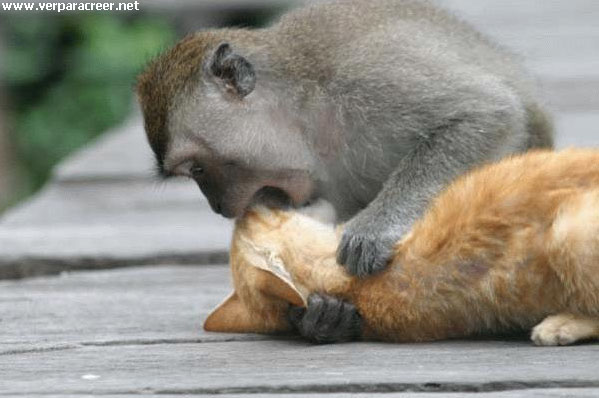
So hungry I could have eaten a monkey....

Man, I was looking forward to eating six bucks worth of chicken and rice on that cruise! I had a fiver and a single all lined up in my wallet, at least $14 dollars worth of liquor in my empty belly, and every intention of chowing down.


But alas it was not to be! The much promised food (at least three mass emails' worth, not to mention a Gawker spot) failed to materialize.


I had to come home and eat my monkey, but only after he had dispatched the cat.

That's life in the Chong Alma!

5.15.2006

Woe is me

NY Times
May 15, 2006

Times Are Tough for News Media, but Journalism Schools Are Still Booming

COLUMBIA, Mo. — These are tough times for journalism.

The newspaper industry cut more than 2,000 jobs last year as it continued to lose readers and advertisers to the Internet. Network newscasts are being propped up by older viewers and continue to lose market share to cable. Regular reports of ethical breaches are undermining public trust in all news organizations, bloggers accuse the mainstream media of being arrogant and clueless, and Wall Street expresses little confidence in its financial future.

But there is one corner of the profession still enjoying a boom: journalism schools.

Demand for seats in the nation's journalism schools and programs remains robust, and those schools and programs are expanding. This month, they will churn out more graduates than ever into a job market that is perhaps more welcoming to entry-level multimedia-taskers than it is to veterans who began their careers hunting and pecking on Olivetti typewriters.

"If you've got the skills, the jobs are there," Diego Sorbara, who is graduating shortly from the Missouri School of Journalism here, said with the confidence of a 22-year-old who has lined up two jobs, first as a copy editor at The Milwaukee Journal-Sentinel this summer, then as a copy editor and page designer at The Rocky Mountain News.

"Newspaper people are too pessimistic," he said. "Part of the nature of journalism is to adapt to your surroundings. We can't all stay in our ruts. If you get into this whole spiral of, 'Woe is us, the industry is going down,' then it will go down."

Michele Steele, 27, who is graduating from the Graduate School of Journalism at Columbia University in New York, has a similar outlook. She has been hired as a reporter and anchor for the video network at Forbes magazine's Web site, www.forbes.com.

"Certainly the industry is changing," Ms. Steele said as she monitored the Forbes Web site in the school's new Roone Arledge Broadcast Lab, named after the former head of ABC News. "But the changes are positive."

Some of those changes are being reflected on the nation's campuses, where new media is being taught alongside the old.

Missouri's journalism school — the oldest in the country — is building a new institute with a $31 million grant from the Donald W. Reynolds Foundation for a "convergence center," where journalists and ordinary citizens can study emerging media technologies and new approaches to journalism and advertising.

In New York, Columbia just opened the multimillion-dollar Arledge digital television lab and last fall introduced a new one-year master of arts program in which student journalists can concentrate in a field like business or the arts. It plans to open a new center for investigative journalism this summer.

In addition to such established schools, other new options are arising. Steven Brill, the founder of The American Lawyer and Court TV, and his wife, Cynthia, gave $1 million earlier this year for a new journalism program at Yale. And the City University of New York is opening a whole new Graduate School of Journalism in September. It is even reclaiming an old-media landmark, the New York Herald Tribune building in Midtown Manhattan.

In 2004, the latest year for which there are comprehensive statistics, freshman enrollments in more than 450 journalism and mass communications programs across the country increased 5.2 percent over the previous year, marking the 11th consecutive year of growth. The figures are compiled by a team led by Lee B. Becker, a professor in the Grady College of Journalism and Mass Communication at the University of Georgia, who has surveyed journalism enrollments and the job market for two decades.

"There is no evidence as of yet that any of these discussions of gloom and doom in the industries, and particularly the newspaper industry, are having any adverse affect on enrollments," Mr. Becker said, although his survey did show a slowing of the growth rate from 2003 to 2004.

"Students are interested in writing," he said. "They're interested in the broader sense of what the media are and what role they play in society, and those are the things that drive them, not hearing about Knight Ridder dealing with a stockholders' revolt."

Students are also driven by the very changes that are upending the old media. For one thing, many do not read the print version of newspapers. As Dustin Hodges, 22, who is graduating from Missouri in August, put it, "I don't pick up a newspaper unless it's in front of me and it's free." For the latest news, he hops online, where he spends three or four hours a day anyway.

Today's students have grown up immersed in the Internet and with the ability to adapt rapidly to new technologies, giving them a comfort level with things that newspapers are just discovering, like blogs, podcasts and video clips.

Richard J. Roth, senior associate dean of the Medill School of Journalism at Northwestern University — where the number of applicants has increased every year for the last six years — likes to note that one of his school's graduates is Kevin Sites, who has become a pioneering one-man multimedia foreign correspondent for Yahoo.

He said newspapers were replacing older journalists with those, like Mr. Sites, who were grounded in the basics of news but could also present it in an array of formats.

"They're just buying out the people who are earning at the top and replacing them with people at the bottom," he said, "but those people at the bottom know how to put up podcasts and video."

Unlike some older journalists who may feel threatened by the digital world, today's students are so at home in it that some know more than their professors.

"We're maybe one step ahead of them, and sometimes they're two or three steps ahead of us," said Mike McKean, chairman of Missouri's convergence journalism faculty. "Things are changing so quickly that it's not so much about learning a particular tool or software. It's more about an attitude of working in teams and producing content for different audiences."

At the same time, Brian S. Brooks, the associate dean of undergraduate studies, said Missouri was still emphasizing basic reporting and writing. "We're still making students drill down in the existing media," he said. "That's where the jobs are. You don't want to get too far out in front of the industry."

At Columbia in New York, one multimedia student, Julia Kumari Drapkin, said she was having just that experience.

Ms. Drapkin, 27, a photographer who had taken pictures in Sri Lanka after the tsunami and in New Orleans after Hurricane Katrina, went to Columbia to broaden her skills. She said that some news organizations were not yet ready to allow photographers to write, for example, or shoot video, but she did find a summer internship at Time magazine and its Web site, where she said she would be encouraged to help "rethink the photo essay."

"In this changing media landscape, there's an opportunity for us to be able to do a new kind of reporting," she said. At Time, she said, "there will be conversations about how to handle the new media and I want to be part of that conversation."

Stephen B. Shepard, the founding dean of the City University's journalism school, said journalism education was more valuable to students these days than in years past, in part because news organizations were less able to provide on-the-job training. "There are more demands on people; staffs have been cut, everyone is watching the bottom line and you can't get the training and mentoring that you used to get," he said.

But like many young people just starting their careers, many new journalism graduates seem unfazed by these challenges.

Jake Jost, 24, who interned with Lisa Myers, a senior investigative reporter for NBC News in Washington last year, said that news organizations would always need people with basic skills. "By doing solid news, we can make ourselves relevant to viewers and they'll come back," he said.

At Columbia, Emily Brady, 29, was waiting to talk to a recruiter from Newsday, the Long Island newspaper beset with woes ever since a circulation scandal in 2004. "You don't go into this profession to get rich," Ms. Brady said. "There are financial sacrifices, it's a tough profession, you're under fire, and it's not necessarily the most popular thing to say you're a journalist," she said. "But it's a calling."

5.09.2006

Booze Cruise 2006


From Gawker:
"Columbia J-School Teaches Its Kids to Drink"

There is no more important training for a young journalist than a lesson in how to hold your liquor. And there is no better way to learn to hold your liquor than at an open bar you can’t get from. Hence the annual Columbia J-School booze cruise, at which this year — this is our favorite part — it seems the cocktailing will begin at 4 p.m. Of course, while an open bar would be ideal, the j-school currently charges its students a mere $38,500 in tuition and fees, and so it can afford only a cash bar. And, even better, a “cash food bar” — unless students shell out six bucks for the buffet, they’re stuck with only “chips and salsa, and crudite with herbed dipping sauce.” Dress is “reporter semi-formal,” which seems easy enough until you remember how reporters dress.

Full link here: http://www.gawker.com/news/columbia-journalism-school/columbia-jschool-teaches-its-kids-to-drink-172573.php

Invisible bitch-slaps

As a foreigner, I have no family in town for graduation and therefore no need for those golden tickets. Out of the kindess (some would say softness) of my heart, I've already given away three out of four.

Now, I'm sure there's a few skeptics of the market at School, but I've decided to employ the invisible hand to pickpocket some of my tuition fees.

Therefore, my remaining ticket (gravy) is to be auctioned off to the highest bidder.

Place your bids in the comments section (in-kind bids - drinks, meals etc. - are accepted, even encouraged).

This auction will close at 6pm, May 15, sharp. I'll contact the winner directly.

Cheers,
Matt

5.06.2006


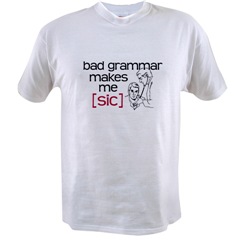
Another suggestion for our j-school t-shirt?

4.04.2006

Troubles

From "The Infiltrator" in the April 2006 Atlantic Monthly:

In Belfast I met with Denis Donaldson, a Sinn Féin party leader and an IRA veteran alleged to have run the IRA’s intelligence wing...His face seemed thin and gray, the face of a man who senses an end looming.

A few weeks later, back in the United States, I received a phone call early one morning from a source in the United Kingdom. He said, “Yer man Denis Donaldson”—the legendary IRA hunger-striker who had met with me in his kitchen—“has just been expelled from Sinn Féin, about three minutes ago. For being a British spy.”

From today's Washington Post:

A former official in the Sinn Fein political party who was recently exposed as a British spy was found fatally shot Tuesday, after apparently being tortured, police said.

Denis Donaldson, 55, died in his isolated home in Glenties in northwest Ireland, said the Irish justice minister, Michael McDowell, adding that Donaldson's right forearm had been nearly severed.

4.03.2006

talk about a tough source

The blog is pretty quiet, so it's as good as any time to post this. I was e-mailed this article with the following note: "Ah, the risks of being a journalist!"

From the AP:
Computer game teaches news skills to journalists
by Peter Svensson

To teach fact-finding skills, professors at the University of Minnesota have turned the fantasy computer game "Neverwinter Nights" into a tool for journalism students.

Instead of slaying monsters and gathering gold, the players tackle sources and gather information.

"When we initially did the game, it still had lava pits, the editor looked like an ogre — stuff like that. The librarian had breastplates," said Nora Paul, director of the university's Institute for New Media Studies.

The team, which includes game designer Matt Taylor and journalism professor Kathleen Hansen, have now modified the game graphics to look like a modern town, the fictional Harperville.

A train has derailed, spilling toxic ammonia, and the players are sent out to cover the story. They dig up information by going to the library, government offices or talking to a retired train engineer at the bar.

For each step of a conversation, the players have four choices of what to tell to the interview subjects, ranging in attitude from assertive to tentative. If players are too brash, the interview subjects will say "Excuse me, I don't like your attitude," and end the conversation.

The goals of the game are not only to reinforce the thinking process behind information gathering and distinguishing between different types of sources, but also to teach etiquette, Paul says.

The team had initially planned to have a crowd of game characters milling about the accident scene, but the game wasn't amenable to that. A bug in the program meant that any time a player approached a group of people, he was immediately attacked and killed.

3.09.2006

it could have been worse, people...

McClatchy Looks Like the Favorite
To Buy Knight Ridder at Auction
By JOSEPH T. HALLINAN and DENNIS K. BERMAN
March 10, 2006
McClatchy Co. appeared yesterday in the pole position to purchase the Knight Ridder Inc. newspaper chain, people familiar with the matter said, offering a combination of cash and stock valued at more than $65 a share, or more than $4.35 billion.

Bids for Knight Ridder were due yesterday at 5 p.m. EST, and, as in any auction, the situation was fluid and subject to change, even past the stated deadline. But a consensus was building that McClatchy was the favorite, as it appeared MediaNews Group Inc. was fading from the scene and a large private-equity group including Texas Pacific Group and Thomas H. Lee Partners was showing an indication of interest -- albeit at a lower, all-cash price.

McClatchy publishes the Star Tribune in Minneapolis, the Sacramento Bee and other papers. Knight Ridder, the nation's second-largest newspaper publisher by circulation behind Gannett Co., publishes 32 papers, including the Philadelphia Inquirer and Miami Herald.

Knight Ridder's board will have to weigh a complex mix of price, certainty of closing a deal and journalistic continuity as it examines the bids. With the auction entering its final stages, there could well be a surprise development or a dark-horse bidder that emerges.

Knight Ridder spokesman Polk Laffoon declined to comment. McClatchy spokeswoman Elaine Lintecum also wouldn't comment.

The auction has so far drawn a tepid response from investors.

"I'm absolutely on the fence," said Thomas A. Russo, partner in Gardner Russo & Gardner, a Lancaster, Pa., investment firm that holds 6.3% of McClatchy's Class A stock.

He said McClatchy's own low price -- its stock closed yesterday at a 52-week low -- makes it tempting for the Sacramento, Calif., company to use its cash to buy back its own shares instead those of another company. In 4 p.m. New York Stock Exchange composite trading, shares of McClatchy fell 47 cents to $51.93. Shares of Knight Ridder, based in San Jose, Calif., rose 20 cents to $62.66 on the Big Board.

But McClatchy has almost no debt, putting it in a strong position to borrow heavily to make a big acquisition. This is exactly what it did in 1997, when the company surprised Wall Street by agreeing to buy Cowles Media Co., publisher of the Star Tribune, for about $1.4 billion in cash and stock.

McClatchy Chief Executive Gary Pruitt was criticized at the time for paying such a high price for the paper. But he was able to use the cash generated by the business to quickly pay down debt.

Merrill Lynch & Co. analyst Lauren Rich Fine, in a note to investors, estimates that an all-cash deal for Knight Ridder would actually add to free cash flow per share -- a requirement Mr. Pruitt has identified as being necessary for an acquisition by McClatchy.

If the bids for Knight Ridder are insufficient, there remains the possibility that Knight Ridder's board could consider a recapitalization and engage in a large share-buyback program. At year's end, the company had 66.9 million shares outstanding. Its market capitalization is $4.21 billion.

2.27.2006

Otis Chandler Dies

From the LA Times obit:

L.A. Icon Otis Chandler Dies at 78
By David Shaw and Mitchell Landsberg
Times Staff Writers

11:58 AM PST, February 27, 2006

Otis Chandler, whose vision and determination as publisher of the Los Angeles Times from 1960 to 1980 catapulted the paper from mediocrity into the front ranks of American journalism, died today of a degenerative illness called Lewy body disease. He was 78.

Chandler died at his home in Ojai about 4 a.m., according to Tom Johnson, a former publisher of The Times who was acting as a spokesman for the family. Chandler's wife, Bettina, was with him. Other family members had gathered at the Chandler home.

"Otis Chandler will go down as one of the most important figures in newspaper history," said Dean Baquet, editor of the Los Angeles Times. "He built a newspaper that was as great as the city it covers. He set his sights on a goal — making The Times one of the two or three great American papers — and he pulled it off."

Lewy body disease is a brain disorder combining some of the most debilitating characteristics of Parkinson's and Alzheimer's diseases. Victims suffer from severe dementia, as well as the stiffness, tremors and impaired movements characteristic of Parkinson's. The disease is known for its fast progression. Chandler was diagnosed seven months ago, although doctors had determined about a year earlier that he was suffering from some form of dementia, his wife said. As recently as September, Chandler appeared fit, aside from a knee injury, and was lucid enough to sit for an interview and give a visitor a guided tour of his classic car and motorcycle museum in Oxnard.

Chandler was the great-grandson of Gen. Harrison Gray Otis, the blustery Civil War veteran who bought part-ownership of The Times in 1882, a year after it began publication, and was its publisher for 35 years. Chandler's grandfather and father followed Gen. Otis in the publisher's chair. The Chandlers had no rival as the most powerful family in Southern California. They owned vast landholdings and used their influence with elected officials and the business elite to shape the region's development.

But it was Otis Chandler — a world-class shotputter in college and a fierce competitor in every arena he entered — who took charge of a paper that for decades had generated almost as much ridicule as revenue and transformed it into one of the best newspapers in the country. He also made it more profitable than ever.

"No publisher in America improved a paper so quickly on so grand a scale, took a paper that was marginal in qualities and brought it to excellence as Otis Chandler did," David Halberstam wrote in "The Powers That Be," his 1979 book about the news media.

"You cannot overstate the importance of Otis Chandler's impact on the Los Angeles Times, the newspaper industry and all of Southern California," said current Times Publisher Jeff Johnson (no relation to Tom Johnson). "He was bold in making changes and investments in the paper that transformed The Times into a world-class news organization."

"Otis was a giant in every way," said Donald Graham, chief executive officer and chairman of the board of the Washington Post Co. "The paper you are reading is his monument. By his strength and by his judgment of good journalists, he was of unique importance in the history of the Los Angeles Times."

During Chandler's 20 years as publisher — and five subsequent years as editor in chief and chairman of the board of The Times' then-parent company, Times Mirror — the paper won nine Pulitzer Prizes and expanded from two to 34 foreign and domestic bureaus. At the same time, it doubled its circulation to more than 1 million daily and for many years during and after his tenure published more news — and more advertising — than any other newspaper in the United States.

2.21.2006

RIP

2.20.2006

thy breath be rude

2.17.2006

Snowflakes Across The Western World


Rumsfeld speaks, you decide:

First, from the Fox TV affiliate via AP in San Diego
NEW YORK (AP) - Defense Secretary Donald Rumsfeld says the U.S. is prey to an "unacceptable, dangerous deficiency" in the way it talks to the world.

In a speech in New York, Rumsfeld said Al-Qaida and Islamic extremist groups have become expert at using the Internet to poison Muslim viewpoints. Rumsfeld tells the Council on Foreign Relations, "our government has not adapted."

Rumsfeld says the military has to adapt to changes in global media and better train officials about the importance of "timing and rapid response."

Rumsfeld calls the government's public affairs system antiquated. He says officials who work an eight-hour, five-day schedule can't keep up with a 24/7 world.

Next, the BBC
The US is losing the propaganda war against al-Qaeda and other enemies, defence chief Donald Rumsfeld has said.

It must modernise its methods to win the minds of Muslims in the "war on terror", as "enemies had skilfully adapted" to the media age, he said.

Washington and the army must respond faster to events and learn to exploit the internet and satellite TV, he said.

Separately, President Bush said the US should not be discouraged by setbacks in Iraq and must realise it is at war.

"We shouldn't be discouraged... because we've seen democracy change the world in the past," George W Bush said.

However, he also used his speech in Florida to claim progress in the war on al-Qaeda.

Mr Bush said that slowly but surely the US was finding terrorists where they hid.

'Newsroom battles'

Correspondents say that in recent months victory in the battle for public opinion has become a new front for the Bush administration.

In a speech to the Council of Foreign Relations, Mr Rumsfeld said some of the US' most critical battles were now in the "newsrooms".

"Our enemies have skilfully adapted to fighting wars in today's media age, but... our country has not," he said.

Mr Rumsfeld said al-Qaeda and other Islamic extremists were bombarding Muslims with negative images of the West, which had poisoned the public view of the US.

The US must fight back by operating a more effective, 24-hour propaganda machine, or risk a "dangerous deficiency," he said.

Government communications planning must be "a central component of every aspect of this struggle", he added.

"The longer it takes to put a strategic communications framework into place, the more we can be certain that the vacuum will be filled by the enemy."

Finally, The Australian

THE United States lags dangerously behind al Qaeda and other enemies in getting out information in the digital media age and must update its old-fashioned methods, Defence Secretary Donald Rumsfeld said overnight.

Modernisation is crucial to winning the hearts and minds of Muslims worldwide who are bombarded with negative images of the West, Mr Rumsfeld told the Council on Foreign Relations.

The Pentagon chief said today's weapons of war included e-mail, Blackberries, instant messaging, digital cameras and Web logs, or blogs.

"Our enemies have skilfully adapted to fighting wars in today's media age, but ... our country has not adapted," Mr Rumsfeld said.

"For the most part, the US government still functions as a 'five and dime' store in an eBay world," Mr Rumsfeld said, referring to old-fashioned US retail stores and the online auction house, respectively.

Mr Rumsfeld said US military public affairs officers must learn to anticipate news and respond faster, and good public affairs officers should be rewarded with promotions.

The military's information offices still operate mostly eight hours a day, five or six days a week while the challenges they faces occur 24 hours a day, seven days a week. Mr Rumsfeld called that a "dangerous deficiency."

Massachusetts Sen. Ted Kennedy of the opposition Democratic Party immediately criticised Mr Rumsfeld as missing the point.

"Clearly, we need to improve our public diplomacy and information age communication in the Muslim world," Mr Kennedy said in a statement. "But nothing has done more to encourage increased Al Qaeda recruitment and made America less safe than the war in Iraq and the incompetent way it's been managed. Our greatest failure is our policy."

Mr Rumsfeld lamented that vast media attention about US abuses at Abu Ghraib prison in Iraq outweighed that given to the discovery of "Saddam Hussein's mass graves."

On the emergence of satellite television and other media not under Arab state control, he said, "While al Qaeda and extremist movements have utilised this forum for many years ... we in the government have barely even begun to compete in

2.13.2006

Autoplagiarism

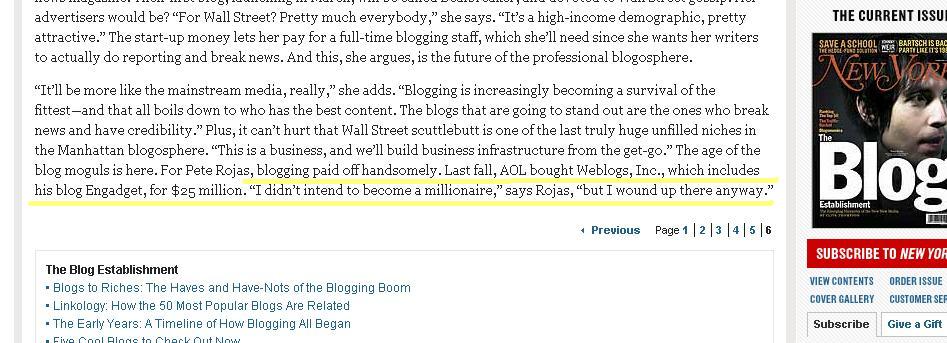
In a New York article about the blog hierarchy, the same quote appears three times: in the middle of the article, as a pull quote, and as a kicker. I saw this online--maybe the print version is different. But have you ever seen the same quote used more than once in the same article?

Page 3:

For Rojas, the toil paid off handsomely. Last fall, AOL bought Jason Calacanis’s company Weblogs, Inc., which includes Engadget, for $25 million...“I didn’t intend to become a millionaire,” he says, “but I wound up there anyway.”


Page 6:

Last fall, AOL bought Weblogs, Inc., which includes his blog Engadget, for $25 million. “I didn’t intend to become a millionaire,” says Rojas, “but I wound up there anyway.”


Pull quote on page 4:

I can understand being excited over a good quote, especially when you try to explain the metholodogy behind a network theory-based analysis of the blogosphere in your lede. But thrice?

My response to the Bonnie Fuller fiasco


Bonnie Talks!
Tab queen exclusive shocks, dismays innocent journalism students.
By Sara Cardace
New York Magazine

Columbia J-schoolers got a lesson in too-good-to-check journalism when they had tabloid doyenne Bonnie Fuller (who runs the Enquirer and Star) in to speak in late January. Women’s Wear Daily reported that it was “an invitation she accepted, in part, because she hoped to attract recruits to her magazines”—which set off a blog firestorm and a mildly hysterical column in Ad Age. WWD also quoted Columbia Society of Professional Journalists speakers director Amanda Millner-Fairbanks, 26, seemingly commending Fuller as “sort of the mother hen of this new form that’s taken hold and is very profitable.” All of which left Millner-Fairbanks exasperated. First off, she says, Fuller’s publicist had pitched the idea—hard—to them, not the other way around. Plus, she felt the WWD quote was out of context. “It’s not like we were giving her an excellence-in-journalism award—it’s not as if we invited her and Judy Miller in for a luncheon,” she says. “The whole thing makes me feel a bit trepidatious about entering this world, where the codes of conduct are such a gray area.” Still, Fuller did say she was hiring.

Link: http://www.newyorkmagazine.com/news/intelligencer/15956/index.html

2.09.2006

Mad about Bonnie Fuller

SHOCKER: OPRAH PREGNANT WITH JAMES FREY'S BABY!
And Bonnie Fuller Lectures the Society of Professional Journalists!

Insiders say that embattled faux-memorist James Frey and talk-show goddess Oprah Winfrey have not only reconciled following their notorious on-camera falling out, but have been secretly seeing each other. Now, says a friend of the new couple, Winfrey is pregnant with Frey’s lovechild.

The intense romance began Jan. 26, “backstage after James was on the show,” says a source close to Harpo, Oprah’s production company. “James broke down in tears and Oprah hugged him, holding him tight. I think they both realized right then and there how much they really cared for each other.” Frey’s very public dressing-down, says the source, culminated in “some hot-and-heavy undressing” behind closed doors. A friend of Winfrey and her stunned, now-ex-boyfriend Steadman Graham notes that Winfrey’s baby bump also comes as a surprise because the pregnancy came unusually fast, particularly for a 52-year-old woman. “But she’s Oprah, y’all. And if Oprah puts her mind to it, Oprah can do anything.”

There. Can I give a guest lecture to Columbia University students now?

Because in late January, Bonnie Fuller -- the editorial director of such journalistic pantheons as Star, Celebrity Living and Globe -- got to. She was invited to Columbia’s Graduate School of JOURNALISM by the Columbia chapter of the Society of Professional JOURNALISTS (SPJ). To speak about ... JOURNALISM.

What the $#*&$)*@???

Can’t we just admit, finally, once and for all, that Bonnie Fuller certainly does something compelling and entertaining, but it is not, for the most part, journalism? Her publications, after all, routinely rely on “sources” that again and again prove to be ... shall we say, wrong?

I mean, good for Oprah that she’s been able to direct laser-like focus on the issue of veracity, or lack thereof, in book publishing -- and I’m thrilled that everyone keeps calling for the obvious: that Frey’s books should get shifted from the nonfiction best-seller lists to the fiction lists. But while we’re at it, I want to formally call for the reclassification of the celebrity tabloids -- particularly those under Fuller’s purview -- from “journalism” to “non-journalism.”

If we don’t, apparently an entire generation of young journalists might think that the advice of people like Fuller is worth heeding. Young journalists like Amanda Millner-Fairbanks, the woman that Women’s Wear Daily says is responsible for lining up speakers for the Columbia SPJ chapter. Fuller, Millner-Fairbanks told WWD’s Jeff Bercovici, is “sort of the mother hen of this new form that’s taken hold and is very profitable,” thus justifying the speaking engagement.

Oy.

I used to keep the most astonishingly preposterous issues of the celebrity tabs, like the Star with the now-legendary “IT’S BABY TIME!” cover (right as unpregnant Jennifer Aniston and Brad Pitt were announcing their split). And Celebrity Living’s “JESSICA’S BABY WEIGHT BATTLE!” issue (right as unpregnant Jessica Simpson and Nick Lachey were splitting). Not to mention Globe’s stellar Scott Peterson trial issue, with its “SCOTT WILL WALK FREE!” cover (which, in a classy bonus, also offered a “CHRIS REEVE -- WAS IT SUICIDE?” headline).

Unfortunately, running out of storage space, I tossed most of them. But now I’m regretting that I didn’t donate them to Columbia so that the kids there could learn all about the exciting new field of non-journalism.

Of course, I defend Columbia’s right to host controversial speakers. But did Fuller have to get humored by J-schoolers? Isn’t there some other wacky group -- some Columbia version of Harvard’s Hasty Pudding Theatricals -- that could have hosted her instead of student journalists?

For years I’ve said that “celebrity journalism” is as accurate as horoscopes. So, what the hell, why doesn’t Columbia’s SPJ chapter track down a “very profitable” astrologist who can offer students some reporting tips? And why don’t some of the photography students in Columbia’s MFA program invite a guest speaker from the ranks of the stalkarazzi that Fuller’s celebrity tabs have aided and abetted so forcefully?

But then again, maybe someone from Columbia will, Oprah-style, get on TV -- cable access or even YouTube would be fine with me -- and say, “We made a mistake and we left the impression that the truth does not matter, and we are deeply sorry about that because that is not what we believe.”

By the way, I’m happy to report that Oprah and James are expecting a baby girl. Friends say they intend to name it Bonnie.

It's not quite an internship at the New Yorker...

Internships ... that Playgirl needs editorial interns who want to learn the nuts and bolts (no pun intended) of magazine publishing, are comfortable with sexual material, and preferably have a good sense of humor. You will get to write for the magazine, proofread and fact-check, read lots of smut, check out naked dudes obviously, help out with promotions, etc. The atmosphere is laid-back and fun, and you will never want for sex toys. Please send resume & clips to cokane@playgirlmag.com.

2.03.2006

Tab Drinkers Anonymous: Steve Isaacs in Talk of Town


The New Yorker: The Talk of the Town
BEVERAGE NEWS
TAB SCARE
by Ben McGrath

As if the mainstream media were not beleaguered enough, now comes word that the Coca-Cola Company is about to release a ne drink called Tab Energy. The plan is to capitalize on the popularity of the Red Bull genre while trading on the retro cachet of Tab, wit those iconic pink cans—a plan that could threaten the sanctity of one of journalism’s secret, and most self-conscious, power cliques: the cult of Tab lovers, who have persisted in drinking the pioneering diet soda, despite its virtual disappearance from the market.

“This is a lonely but inspired society,” David Bradley, the owner of The Atlantic Monthly and National Journal, said recently, before news of the brand’s reëngineering had spread. “You can’t imagine the purchasing and trucking and warehousing issues we address in getting Tab into Washington.”

The original Tab, which appeared in 1963, is still produced, though in dwindling quantities. You’d be unlikely to find it at Gristedes, however, because Coke stopped promoting the drink in the mid-eighties, after the cancer scare involving saccharin, an artificial sweetener used in Tab. Present-day Tab enthusiasts must seek out wholesalers (New York Beverage, in the Bronx, is a local favorite) or rely on a kind of sixth soda sense—“the ability to spot the pink,” David Edelstein, the film critic for New York, calls it—in obtaining their daily fixes.

Here in the city, drinkers include Steven Brill and Danny Goldberg, the C.E.O. of the radio network Air America, each of whom has an office fridge stocked with Tab. “I have unadulterated enthusiasm for it,” Goldberg said, adding that he has long since delegated the task of finding the stuff to an assistant.

The fact that Tab comes in a pink can and was conceived as a drink for women seems only to have bolstered the appeal—it’s a “boy named Sue thing,” according to a financier, who picked up the habit from Bradley. (Brill, just to be sure, tends to crush his Tab cans as he drains them.) Then, there is the peculiar flavor (“It tastes like metal”) and the reputation for unhealthiness, a combination that Edelstein, who has four cases delivered to his house every other week, believes gives Tab “the courage of its convictions.”

Steve Isaacs, a self-described “Tab nut” and former Washington Post editor who teaches at the Columbia Journalism School, has been told by several doctors not to drink it. “I tell them to go to hell,” he said recently. Isaacs used to work at CBS, where his boss, Van Gordon Sauter, often drank two Tabs at breakfast. Now Isaacs may be the most influential Tab advocate in the business: he begins each semester by holding up a Tab and asking students to come up with a hundred story ideas inspired by the can.

At the end of last term, Isaacs threw a party for his students, at which he served Tab. “I was surprised at how many of them drank it,” he said. “One was putting Scotch in it. I mean, that sounds fucking awful.” Isaacs no longer drinks alcohol, for health reasons, but he doesn’t much mind, because he thinks that the flinty taste of Tab is like a fine Sancerre.

Tab Energy, for its part, is “really good-tasting,” according to a Coke spokesman, and “reminiscent of a liquid Jolly Rancher,” according to Fashion Week Daily, which recommends vodka as a mixer. The new can is slimmer, but it’s still pink, with the same Pop-art font. Whereas old Tab has thirty-one milligrams of caffeine and zero calories, Tab Energy has ninety-five milligrams and five calories. Nicole Richie is an early proponent, which seems right—more Los Angeles than New York. (To be fair, Tori Spelling and Bobcat Goldthwait are reported to be fans of original Tab.)

Coke officials promise that the old Tab isn’t going to be retired, which is good news for Edelstein. “For the last thirty years, through marriage, kids, fluctuations in my financial situation, Tab has been the one constant in my life,” he said. He was holding a glass of bourbon, but he swore that the taste of Tab lingered in his mouth. “Not to boast, but I’ve had eight cans today,” he said.

Article link: http://www.newyorker.com/printables/talk/060206ta_talk_mcgrath

1.31.2006

Intern or maid?

I can't believe they consider this an internship. Sad what someone would do (really, though?) for a line on a resume.
http://www.gawker.com/news/columbia-journalism-school/but-do-columbia-jschoolers-do-windows-151609.php

1.26.2006

Don't let James Fr(e)y!


Is anyone else concerned after watching Oprah today that James Frey might join his girlfriend "Lilly" and commit suicide soon? I'm just saying, the poor guy (well, the poor rich guy) looked so depressed and zoned out I swear he was counting pills in his head.

I'm not defending what he did (which by my accounts is called LYING not "embellishing") but I feel bad for him. I mean, Oprah basically yelled at him on national television! And unlike some people, Oprah never yells! If you've been called out by Oprah you KNOW you've done wrong.

If he does indeed end his own life, does this count as irony? And more importantly, will anyone believe that he's dead?

I'm thinking of making "Save James" t-shirts. Who's with me?

1.25.2006

The Weekly Standard takes on the J-school

Conservative blogger and talk show host Hugh Hewitt spent a few days at the school last fall, interviewing Dean Lemann and others and sitting in on Michael Shapiro's RWI class. His article can be read by clicking here

It is not a happy read. He thinks (and hopes) journalism is dead or dying.

Here's a taste:

"I concluded by asking them if they 'think George Bush is something of a dolt.' There was unanimous agreement with this proposition, one of the widely shared views within elite media and elsewhere on the left. The president's Harvard MBA and four consecutive victories over Democrats judged 'smarter' than him haven't made even a dent in that prejudice."

1.24.2006

Divine Comedy

Maybe I am dead, and Journalism School is purgatory.
A research group has compiled a list of the most popular brand references or "shout-outs" in mainstream music this past year. They're calling it "American Brandstand." Clever, no?

Not surprisingly, 50 Cent leads the pack after rhyming about everything from Bentleys to Bacardi. It gives a whole new meaning to hip-hop going commercial eh? Check out the list here.

Exciting New Publishing Technology

Introducing the new Bio-Optic Organized Knowledge device, trade named: BOOK

BOOK is a revolutionary breakthrough in technology: no wires, no
electric circuits, no batteries, nothing to be connected or switched
on. It's so easy to use, even a child can operate it.

Compact and portable, it can be used anywhere -- even sitting in an
armchair by the fire -- yet it is powerful enough to hold as much
information as a DVD. Here's how it works:

BOOK is constructed of sequentially numbered sheets of paper
(recyclable), each capable of holding thousands of bits of
information. The pages are locked together with a custom-fit device
called a binder, which keeps the sheets in their correct sequence.

Opaque Paper Technology (OPT) allows manufacturers to use both sides
of the sheet, doubling the information density and cutting costs.
Experts are divided on the prospects for further increases in
information density; for now, BOOKs with more information simply use
more pages.

Each sheet is scanned optically, registering information directly
into your brain. A flick of the finger takes you to the next sheet.
BOOK may be taken up at any time and used merely by opening it.

Unlike other display devices, BOOK never crashes or requires
rebooting and it can even be dropped on the floor or stepped on
without damage.

However, it can become unusable if immersed in water for a
significant period of time. The "browse" feature allows you to move
instantly to any sheet and move forward or backward as you wish.

Many come with an "index" feature, which pinpoints the exact location
of selected information for instant retrieval.

An optional "BOOKmark" accessory allows you to open BOOK to the exact
place you left it in a previous session -- even if the BOOK has been
closed. BOOKmarks fit universal design standards; thus, a single
BOOKmark can be used in BOOKs by various manufacturers. Conversely,
numerous BOOKmarkers can be used in a single BOOK if the user wants to
store numerous views at once. The number is limited only by the number
of pages in the BOOK.

You can also make personal notes next to BOOK text entries with an
optional programming tool, the Portable Erasable Nib Cryptic
Intercommunication Language Stylus (PENCILS).

Portable, durable, and affordable, BOOK is being hailed as a
precursor of a new entertainment wave. Also, BOOK's appeal seems so
certain that thousands of content creators have committed to the
platform and investors are reportedly flocking. Look for a flood of
new titles soon.

1.23.2006

Follow-up on Critical Issues

Who remembers that lovely "Food Lion" exposé we watched in critical issues? Not to mention the ensueing debate...

Anyways, 15 (or was it 20) years later, MSNBC does something similar. The results, however, are not quite the same. Make sure you check out the results.

http://www.msnbc.msn.com/id/10976595/

PS - Am I the only one who had never heard of Food Lion before that class???

12.09.2005

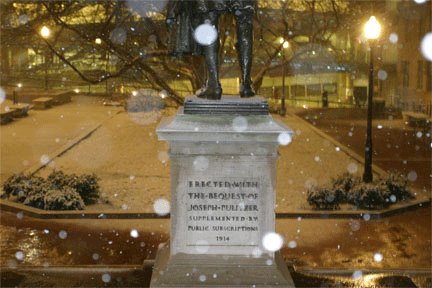
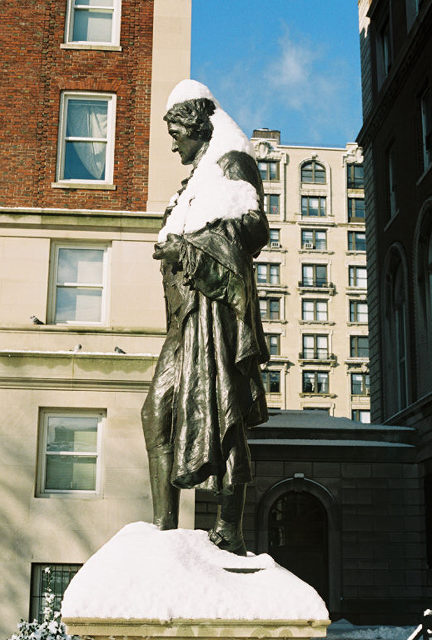
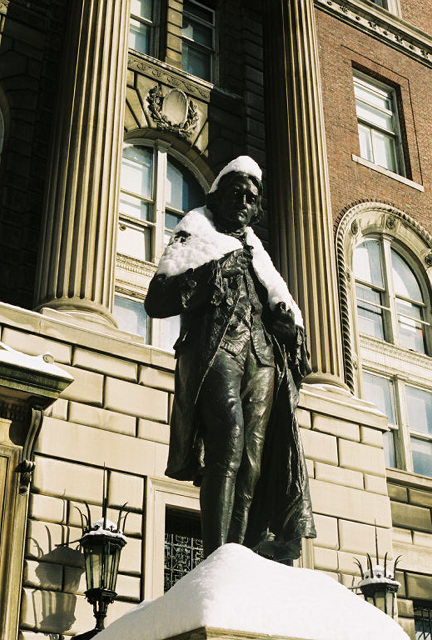
The Many Moods of T. Jefferson

Pope Jefferson

Snowhawk

Captain of the Skies

more snow...

11.17.2005

And we've been fussing about Judith Miller all this time.

Woodward. Not that surprising, and disheartening -- for all the reasons below. From an online columnist I respect a lot:

All The Presidents Stooges

by digby

I can't tell you how impressed I continue to be with the elite journalists in this country. After finding out that top reporters from The NY Times, The Washington Post and NBC all withheld information from the public about their leaders, I can only wonder what else they may be keeping back because of their cozy relationships, book deals, or political sympathies. This is a crisis in journalism.

Matt Cooper was leaked to by Karl Rove in the summer of 2003 and he fought to keep from revealing his source. But he fulfilled his responsibility as a journalist by writing a story and it was the real story about what was going on. Here's the first paragraph of Cooper's first article on the subject back in 2003:

Has the Bush Administration declared war on a former ambassador who conducted a fact-finding mission to probe possible Iraqi interest in African uranium? Perhaps.


I don't know why all the other reporters who were being leaked this nasty bit of business didn't write articles with that lead, but they should have. As we all know, that was the story then and it's the story now. Instead it's only after the long arm of the law reaches into the newsrooms that we find out dozens of reporters, including some of the most famous and powerful, were involved in this little episode.

It turns out that Bob Woodward, who worked hand in glove with the administration to create the hagiography of the codpiece, has known for years that the White House was engaged in a coordinated smear campaign against Joe Wilson. Indeed, he was right in the middle of it. In the beginning he may have thought that it was idle gossip, but by the time he was on Larry King defending it as such he knew damned well that it had been leaked by Rove, Libby and his own source all within a short period of time. He's been around Washington long enough to know a coordinated leak when he sees one.

Novak took the bait and dutifully regurgitated the information. Matt Cooper smelled a rat and wrote about it. It's amazing how many other journalists heard the tale and dismissed the significance or went out of their way to "protect" sources by talking about the case on television every chance they got while pretending they were uninvolved. But none pooh-poohed the story and its significance in public with quite the same fervor as Bush's friend Woody.

I had thought that Tim Russert and Andrea Mitchell were the Lawrence Olivier and Vivien Leigh of this story with their endless "speculation" about an investigation in which they had information that could clear up many of the questions they were fielding. Woody takes the cake. His has been an Oscar worthy performance to rival Meryl Streep. He chewed the scenery so many times on Larry King that he should be given a lifetime achievement award:

(Cue "Battle Hymn of the Republic")

WOODWARD: If the judge would permit it, I would go serve some of her jail time, because I think the principle is that important, and it should be underscored. It's not a casual idea that we have confidential sources. It is absolutely vital. And I'll bet there are all kinds of reporters out there, if we could divvy up this four-month jail sentence -- I suspect the judge would not permit that, but if he would, I'll be first in line. It's that important to our business.


I don't think they could have made a cross big enough for the both of them.

Woodward and Miller have been willing tools of this administration from the get. Bob Novak was an open partisan on television, so everybody knew that they funneled information to him and he printed it for political purposes. These two (and their supporting players in television news) were the most important journalists in Washington working for the two most important papers in the country and the national news outlets. Among all the journalistic players in this, the only one who wrote the real story, in real time, was Matt Cooper. He's the one who should be getting the journalism awards, not Judy Miller. He's the only one who fulfilled his duty as a journalist and told his readers what their leaders were doing.

Perhaps this is the natural outcome of the press corps joining the entertainment industrial complex. It's ironic that one of the men who kicked off this new celebrity journalism with Watergate should emerge as one of the major players in this era's biggest "gate" scandal. I suspect that this time he'll have it in his contract to play himself in the film. After all, he's now bigger than Redford. And he's proven over the last couple of years that he's one of the best actors of his generation.

11.16.2005

Chemical weps in Falluja?

Our Italian friend's response to a previous post:

RaiNews24's doc was on-air a week ago. Here is the link to the english version. It is not balanced (no government voices) but it is accurate and impressive. The footage is scary and disgusting. Many newspapers and tv stations all over Europe are talking about it, and today Lt Col Barry Venablea, a Pentagon spokesman, told the BBC that white posphorus "was used as an incendiary weapon against enemy combatants." The government earlier denied it had been used in Falluja at all. But remember that Washington is not a signatory of an international treaty restricting the use of white phosphorus devices in war. So, for the US it is not a chemical weapon. Enjoy.

Alessandro

11.13.2005

Share Your J-School Photos!

Hey J-Schoolers!

Did you take a photo George Clooney at the Good Night and Good Luck screening? Maybe you got a few shots at the Halloween party, happy hour or some other J-School event. We'd love it if you shared all these great pics with us. Please send your photos to jschoolyearbook@gmail.com.

Thanks!

11.11.2005

Kurt Schork would be proud and sickened

Italian journalists are taking revenge for Nicola Calipari in the best way they can: they've kept working. And now, they bring us news we don't want but may need - about U.S. use of napalm at Fallujah.

In a documentary to be broadcast by RAI, the Italian state broadcaster,
this morning, a former American soldier who fought at Fallujah says: "I
heard the order to pay attention because they were going to use white
phosphorus on Fallujah. In military jargon it's known as Willy Pete


"Phosphorus burns bodies, in fact it melts the flesh all the way down
to the bone ... I saw the burned bodies of women and children.
Phosphorus explodes and forms a cloud. Anyone within a radius of 150
metres is done for."


-- The Independent, US forces 'used chemical weapons' during assault on city of Fallujah

Being twice the age of some of you, I found this a teeny bit of a flashback; I had just turned ten when photos of the napalmed Kim Phuc streamed across the AP wire. Growing up in a Republican household, I was probably still wearing a Nixon button I got from my father. You can likely count me as one of the millions driven by that image to ask more questions about the war in Vietnam. I wonder if this film will do the same.

I'm curious especially what broadcast folks think. And for new media folk - is the quality of the video enough for it to have an impact?

I'm curious to see how much, or little, these images will go from Italian TV and the London Independent to U.S. outlets. Should they, do you think? I also wonder - are people so saturated with fictional violent imagery that they won't have the same impact as 30 years ago?


11.09.2005

Halloween Mad Libs

Some of you participated in the Mad Libs experiment at the Halloween party. The results for Part I and Part II are online.

Too many j-schoolers, not enough PR people

So today I called Herb Scher, the flak for the NY Public Library, for a story on branch libraries' movement toward a six-day week. Actually got him on the phone. But he won't talk to me, he said, because he's had eight Columbia journalism students call him in the past two weeks and he doesn't have time to dig up information and talk to us.
As usual, I was told to check the web site.
Then there was the woman at the Drum Major Institute, who said Tuesday she'd had five calls from j-schoolers in the past few days. Great. I didn't get an interview there either.

Jeopardy Champ has his own board game


Is it sad that I sorta wanna buy this?

11.05.2005

elements of bad style

from my hometown paper, the LATimes:


In praise of a mangled masterpiece

DAVID GELERNTER

November 4, 2005

SOMETIMES A SMALL issue lights a large landscape like a slash of lightning; for a moment we see society with dazzling clarity. A new edition of "The Elements of Style" has just appeared — "Elements" is the classic writers' handbook by William Strunk Jr. and E.B. White. The new version starkly illuminates our disrespect for national treasures.

In 1957, White was asked to revise Strunk's decades-old text. White (who had been Strunk's student at Cornell) agreed, and he published two further revisions in 1972 and '79. The result was not merely brilliant, it was beloved: It's never been out of print. White died in 1985. Then the trouble started. A post-mortem revision appeared in 1999; it has just been republished with pictures by Maira Kalman. To mark the new release, a PR volcano erupted. The New York Public Library even staged a musical "Elements." The new version violates what Strunk and White is all about.

The revision was done anonymously. The only new name on the title page is now the illustrator's. And the reviser has been unfaithful to Strunk and White. For starters, he changed White's signed introduction, a short memoir about Strunk — like reworking a Picasso but leaving the signature. He changed lots of other things too.

According to White, Strunk "felt that the reader was in serious trouble most of the time, a man floundering in a swamp, and that it was the duty of anyone attempting to write English to drain the swamp quickly and get his man up on dry ground, or at least throw him a rope." The revised version tells us that Strunk felt, on the contrary, "that the reader was in serious trouble most of the time, floundering in a swamp, and that it was the duty of anyone attempting to write English to drain this swamp quickly and get the reader up on dry ground, or at least to throw a rope."

"At least to throw a rope?" Throw it where? To whom? The phrase is vague bordering on meaningless. And White's "get his man up on dry ground" hints at the author's personal responsibility to his reader. Of course these are details. But White cared passionately about the details that make for good writing.

The reviser clearly disapproves of the indefinite masculine — "he," "man" and so on — to mean anyone. Fine. Except that White believed the exact opposite, and said so in a rule he added to "Elements": "He has lost all suggestion of maleness in these circumstances." This very issue caused a sad disagreement toward the end of White's long relationship with the New Yorker, a magazine he more than any other author raised to dizzying literary heights. In 1971, White submitted a piece attacking "gender neutral" writing — and the New Yorker rejected it. Dog rejects bone.

The latest "Elements" includes clunkers like this: "When repeating a statement to emphasize it, the writer may need to vary its form. Otherwise, the writer should follow the principle of parallel construction." Here's the way it was actually written: "When repeating a statement to emphasize it, the writer may need to vary its form. But apart from this he should follow the principle of parallel construction."

New words enter the language all the time, as Strunk and White tell us: "Youth invariably speaks to youth in a tongue of his own devising." A memorable phrase, taut as a piano string: "youth speaks to youth." Here is the new, "improved" version: "Youth invariably speaks to other youths in a tongue of their own devising." Who would have thought these small changes could do so much damage, like a monkey wrench through a plate-glass window?

Adding insult to injury, the illustrated edition includes a page of credits, dedications, copyright notices and so forth — each printed separately and placed on the page at strange angles or upside down. Clever. The word "hello" sprawls across the inside front cover in fancy italics; "thank you," "and," "goodbye" appear on three pages at the end.

"Avoid the elaborate, the pretentious, the coy, and the cute," say Strunk and White.

When the 1999 version resurfaced in fancy dress, the New York literary world should have thrown a fit. Instead, it threw a party. But what gives anyone the right to tamper with a masterpiece? American authors had a good year in 1957. Would anyone have the nerve to publish a revised version of a story by Malamud, Shaw, Updike, Nabokov? Or an essay by Mailer, Podhoretz or White himself? True, the language changes. But why couldn't the reviser's bright ideas have appeared as notes surrounding the unchanged original?

What should we make of literati who claim to treasure "Elements" but don't mind seeing it brutally mangled? And here's the larger problem: A society that has no respect for its literary treasures probably — deep down — has no respect for itself.

11.03.2005

Yearbook Portraits

Smile pretty!

The SPJ publications committee is holding three yearbook photo sessions (beginning tomorrow, Friday Nov. 4.) Students have three options for yearbook mug shots: (1) attend a scheduled photo session or email may2109@columbia.edu to schedule an alternate time, (2) submit a photo (preferably digital) to jschoolyearbook@gmail.com or (3) use the facebook photo. The photo deadline for current part-time, full-time, M.A. and Ph.D students is FRIDAY, DEC. 2. If students have not taken or submitted a new photo by this date, the publications committee will go with the facebook photo.

Scheduled Photo Sessions*
WHEN: Friday, Nov. 4, 11 and 18
TIME: 11 a.m. until noon
WHERE: front steps of the J-school building. (We'll relocate to the
student lounge on the 6th floor if the weather is nasty.)

*Photos of M.A. students will be taken Tuesday, Nov. 22 at 6 p.m. following class.

*The committee will schedule additional photo sessions for the incoming part-time students in January.

Fax?

Is there any place in the J-school or thereabouts where we can receive faxes? Preferably for free, but I'm desperate, so...

10.31.2005

ouch.

Trick or Treat

Happy Halloween, y'all, and glad to see so many of you at the party.
Special shout out to Stacey+'becca inter alia (yup, all of you unidentified co-conspirators)

..best costumes: Scott W. and Ted (Luke Skywalker) 'nuff said.

on a total different tip..

Tuition Reform, .. in brief.. costs up, financial aid down.
Columbia is sponsoring a Think Tank this week ( Nov 3-4) to collaborate with policy
makers, researchers, and student leaders on drafting legislative
language for the National Tuition Endowment Act.
(www.TuitionEndowment.org)

I''ll be participating a bit (bearing the yoke of assignments), but holla at me if you have thoughts, comments, think maybe this is a good story or what'eva.

oh, and I am also on the housing committee, so i'm looking for housing complaints/improvements.. might be too late for this year, but for the future. just like the SPJ Academic Affairs folks, who are offering ideas for a better next August..

just think ... of the children.

if not.. you get the gas face
(and props, and a free ashtray, to the first of you who remembers THAT song..and there is actually a Columbia connection) .. i need to get rid of the ashtray. so you can still get it,if you have no idea wtf I am talking about.

10.30.2005

Mind your Ps and Qs

An interesting quote, given Friday's Critical Issues class:

"You can say 'please' and 'thank you' and still ask, 'Did you steal the money?'"


(Quoted in The Investigative Reporter's Handbook, p.105)

10.29.2005

war on whatever

(from WSJ)

Word Flu
By LIONEL SHRIVER
October 22, 2005; Page A6
We've had the War on Poverty, the War on Drugs and the War on Terrorism. It's time for the War on Whatever.

I am not being glib. I have declared war on the word "whatever." More virulent than E coli, more contagious than bird flu, this verbal virus has infected not only the entire population of the United States, but has also reached pandemic proportions in the U.K. (In his last bestseller, the novelist Nick Hornby used four supposedly distinctive first-person voices; and all four narrators, from tough-cookie kid to middle-aged bag, said whatever.) It was bad enough when this pestilence spewed from my friends' mouths like toads. Yet when Donald Rumsfeld testified to Congress this summer that one of the armaments being sent to Iraq was "whatever," I knew we had a national emergency on our hands.

Mr. Rumsfeld's usage was the bug's most innocuous. These days, "whatever" ends a series to mean "and so forth"; alternatively, "some other example I can't think of"; most of the time, "uh." Indeed, if you declare, "I'm going to do a little shopping, meet some friends, whatever," what does the W-word contribute besides a hackneyed gloss of modernity? The adolescent's double-whammy of fillers -- "He's, like, whatever" -- is so impeccably inarticulate as to constitute a triumph.

A cook might commend baking a cobbler using "blueberries, peaches, whatever," and you could infer "or other seasonal fruit." Nevertheless, one would be hardpressed to make heads or tails of a recipe that listed its ingredients as "1/2 c. sugar; 1 T. cornstarch; 2 c. whatever."

An equally commonplace usage is far more exasperating. I will ask my husband, "Do you want pork chops or pasta for dinner?" "Whatever," comes the reply. Various translations present themselves: "I don't give a damn"; "Don't bother me with such trifling domestic considerations"; "I'm not really sure what I feel like eating tonight"; or perhaps most credibly, "I'm not paying any attention to you, and I don't plan to." In any event, I still have no idea whether to take the chops from the fridge or put water on to boil. What would you think of George Bush if you asked him what he plans to do with Social Security, and he said, "Whatever"?

Granted, both eras and locales have their verbal tics. The Irish, for example, are given to the locution, "He speaks grand English, so he does." The compulsively reflexive syntax is charming, at least at first. But "whatever" has grown blandly ubiquitous, and charming it is not. The cool, too, need the clueless. If everybody uses it, it cannot be hip.

I can testify to the fact that, once contracted, this particular virus is fiendishly difficult to purge. Not long ago I realized (too late!) that I had started saying "whatever" myself -- which was a little like looking down and discovering my body covered in suppurating pustules. Take courage! After months of mindfulness, I vanquished the disease. Yet a word of warning, for there is a downside to taking the cure: You will grow hyper-alert to whatever-speak, and everyone else will drive you nuts.

Ms. Shriver's last novel was "We Need to Talk About Kevin" (HarperPerennial, 2004).

10.28.2005

for all the literary journos out there

a word of wisdom from a guy named Frederic Tuten.

Think of yourself as making art -- however bombastic or vague that may sound even to you--and not as a producer of products or units: You will thus relieve yourself of worrying about your work's social or political function, since all art is redemptive, salvational, ennobling and is a protest against ignorance, crime, lies and Death....One beautiful novel shames all broad enterprises and sends brightness through the prison walls of prisons, parliaments, and publishing houses.
I love this because it's an outrageous claim. When you're shouting to keep your courage up, why go halfway?
By novel you can think of any longer work where you take formal risks. (And if you think he's being a religious fanatic or something, check out the magazine where this essay appears.)

10.24.2005

Big news!


Maddox Jolie has been named one of the "50 Most Powerful People Under 39" by Details Magazine. He came in at #2, just behind the fallen soldier and the google guys.

I know, I am just as shocked as you are. He totally should have been #1. =p

investigative fun!

http://www.license.shorturl.com/

10.23.2005

Ye can lead a man up to the university, but ye can't make him think

Does anyone know why Jimmy Breslin gets attributed with the saying, "comfort the afflicted and afflict the comforted." As far as I know, Mencken said that.

10.22.2005

The Sixth Photo

10.21.2005

are co-conspirators journalists?

In case you check this before the law class, here's why Judith Miller is so very interesting to Patrick Fitzgerald. NY Daily News:

Besides Rove and Libby, the group included senior White House aides Karen Hughes, Mary Matalin, James Wilkinson, Nicholas Calio, Condoleezza Rice and Stephen Hadley. WHIG [White House Iraq Group] also was doing more than just public relations, said a second former intel officer.

"They were funneling information to [New York Times reporter] Judy Miller. Judy was a charter member," the source said.

10.20.2005

Is it The Onion? No, it's Reuters

Astrologer Predicts Own Death

BHOPAL, India (Reuters) - Hundreds of Indians flocked to a village in the central state of Madhya Pradesh on Thursday to see if an astrologer who forecast his own death would die as predicted.
Kunjilal Malviya, 75, who lives in Sehara village, about 125 miles south of state capital Bhopal, was meditating in his house after announcing he would die on Thursday.
His family fears his forecast will come true.
"We are afraid of his prediction coming true because all his predictions till date have been correct," his son Anirudh said by phone.
"My father had predicted the death of my grandfather 15 years ago and it came true exactly like he calculated."
Television footage showed relatives and friends seated around Malviya, singing religious songs and reading Hindu texts.
Policemen have been posted near his house to prevent the astrologer from killing himself, authorities said.

NYU student needs sources

I received this plea to post this "advert." If there are any takers, please contact her directly.
RC
____________________

Are you a student who charges for access to your own web cam porn site?

I’m writing an article about students who share their sexual exploits for profit through web cams. I’d like to get a grasp of the ins and outs of the business.

Any prospective source would be greatly appreciated; student need not be from Columbia University.

**ALL INFORMATION IS TREATED WITH THE STRICTEST CONFIDENCE.

Thanks,

Nicole Clarke
Nicole.Clarke@nyu.edu

10.18.2005

was she for real?

After seeing Cynthia McFadden on the post-"Good Night, and Good Luck" panel on Friday, I'm even more shocked and annoyed about this.

What, Me Worry?

"The Big Picture:
2 reminders that journalists once pursued greatness"
By Patrick Goldstein
Los Angeles Times


For a journalist, it's surely a guilty pleasure to see a movie about someone who commits himself wholeheartedly to the pursuit of a story with no thought for the consequences. As portrayed by Philip Seymour Hoffman in "Capote," the New Yorker's Truman Capote was just as cunning and exploitative as any marauding paparazzi in the course of reporting "In Cold Blood," his mesmerizing account of the brutal murder of the Clutter family of Holcomb, Kan.

The man whose book influenced a generation of young journalists was a master of the black art of doing anything to get a story — lying and flattering, deceiving and dissembling nearly every step of the way. When he couldn't get access to Perry Smith and Dick Hickock, the two imprisoned killers, Capote handed the prison warden a $10,000 bribe. He wooed Smith relentlessly, bringing him Thoreau to read in jail. He helped the suspects get a new lawyer so they'd stay alive long enough for him to complete his interviews. And why not, Capote reasoned. As he breathlessly tells his pal Harper Lee after an early meeting with Smith: "He's a gold mine!"

Of course, if you prefer a journalistic hero cast as a white knight instead of a wily charmer, look no further than "Good Night, and Good Luck." Directed and co-written by George Clooney, it chronicles a climactic battle between CBS newsman Edward R. Murrow and Red Scare-era demagogue Sen. Joseph McCarthy. At a time when most journalists are portrayed in TV and film as gushy lightweights — many deservedly so — it's quite a jolt to see someone act like a real hero. Played impeccably by David Strathairn, the laconic, chain-smoking Murrow is uncompromising and incorruptible, like Gary Cooper with a bespoke suit instead of a pair of six-guns.

This pair of artful portraits of two world-class journalists couldn't come at a better time. As you may have heard, morale at newspapers and TV news divisions is at a low ebb, thanks to circulation drops, low ratings and a string of layoffs. As cable news grows more influential each day, network news is scrambling to reinvent itself and hold on to its aging audience. The sense of turmoil is equally apparent in print journalism. With circulation down and costs up, newspapers are in the midst of a wave of soul-searching as they grapple with how to compete with the lightning speed and breezy informality of Internet news sources.

It's nice to have these Hollywood reminders that journalists once pursued greatness, not just ratings and ad linage. One of our biggest challenges these days is facing up to our low standing in public opinion. That's where movies come in — almost since their inception, they've been a reliable barometer of the nation's attitude toward journalists. In the years before the U.S. entered World War II, in such films as "It Happened One Night" and "His Girl Friday," newspapermen were wisecracking working-class heroes, in the racket for the scoop, not the money. By the 1950s, the portrait was less romantic, ranging from the bitingly cynical "Ace in the Hole" to "Sweet Smell of Success," a damning portrait of abuse of power, with Burt Lancaster as a Sith Lord-style Broadway columnist who demolishes everyone in his path.

After Watergate, our crusading image flickered back to life, thanks to films like "All the President's Men" and "The China Syndrome," but by the 1980s, as in "Broadcast News," critiques of hollow careerism were in vogue again. In recent years, the movies are largely focused on journalistic excess and ineptitude, from the portrayal of plagiarist Stephen Glass in "Shattered Glass" to a variety of TV news buffoons, like the one Jim Carrey plays in "Bruce Almighty."

There's a good reason Clooney had a hard time finding anyone to finance "Good Night, and Good Luck." Murrow's rectitude is out of sync with today's cynical attitude about newsgathering. If you asked young moviegoers to cite a typical 21st century journalist, they'd probably point to the doe-eyed young Vanity Fair-style scribe played by Alison Lohman in "Where the Truth Lies," which opened this weekend. Lohman is uncovering a murder mystery about a '50s showbiz team — think Martin and Lewis — whose career is derailed when a beautiful blond turns up dead in their hotel suite. Her investigatory methods include doing drugs, posing as a schoolteacher, wearing outfits that would make Jessica Simpson blush and sleeping with both members of the duo (though not at the same time, as the dead blond did).

It's probably fortunate that Murrow and Capote died young, Murrow of lung cancer, Capote of booze and pills. They would've had precious little good to say about their heirs, especially the ones so enamored of glitz and celebrity. Esquire, once the hallowed home of Norman Mailer, Michael Herr and Gay Talese, is now crammed with fashion advisories — the October issue actually has a style section in which male models, wearing Prada and Armani, pose as paparazzi. In Murrow's day, journalists comforted the afflicted. Today they celebrate the comfortable. Last Thursday, in its House & Home section, the New York Times ran a huge story largely devoted to helping Rupert Murdoch sell his SoHo triplex — he's asking only $28 million.

Even worse, all too many of today's most recognizable journalists — meaning the ones you see on TV or Dominick Dunne — aren't interested so much in uncovering a story as in making themselves part of it. After Hurricane Rita, "The Daily Show" featured a variety of cable newsmen "covering" the story, including a CNN reporter rescuing a puppy and Geraldo helping a wheelchair-bound lady down the stairs of a flooded rest home. As a kicker, Jon Stewart cut to Ed Helms, his correspondent on the scene, who did his report with a man he'd "rescued" slung across his back.

While Capote is guilty of all sorts of unscrupulous behavior in getting his story, once he put pen to paper, he left the stage, allowing his characters to have the spotlight to themselves. What makes "In Cold Blood" so sobering, now that the movie has allowed us to see its author at work, is that it undermines many of our bromides about good journalism. Though a pivotal work of reporting, it is also a fascinating test of our eternal "do the ends justify the means" debate: Do you judge a writer by his brilliant work or by the deception that went into creating it?

Capote isn't the only journalist to cut corners getting his story. As Marc Weingarten writes in his new history of New Journalism, "The Gang That Wouldn't Write Straight," when Hunter S. Thompson didn't have an ending for his book "Hell's Angels," he deliberately provoked the Angels into giving him a sound thrashing to give the book a more dramatic conclusion. Even now, decades later, the Angels are ticked off that Thompson made them look like the heavies.

As Joan Didion warned three decades ago, "Writers are always selling somebody out." They are usually selling a point of view too. "Capote" and "Good Night, and Good Luck" demonstrate how little the hallowed journalistic notion of objectivity applies to their central characters' work. Battling McCarthy, Murrow is clearly a partisan voice, willing to risk his reputation — and his job — by taking up the cause of a man who was kicked out of the Air Force for supposed communist ties.

Defending his adversarial stance, Murrow said, having searched his conscience, "I simply cannot accept that there are, on every story, two equal and logical sides to an argument." This is a far cry from how today's TV mavens would handle McCarthy. They'd simply referee a squabble between the witch hunter and one of his antagonists, letting the audience decide who offered the more persuasive retorts.

If Murrow comes off more as admirable than Capote, his righteousness trumping Truman's narcissism, it's because we see that while Capote's work took a huge emotional toll — he never finished another book after "In Cold Blood" — Murrow's courage was in support of a greater cause, our freedom of speech. Standing up to a bully always earns bigger applause than empathizing with a killer.

Still, it is Capote who turned out to have the larger influence on modern-day journalism. Murrow's quiet authority is completely out of fashion in a TV news world that has become a carnival of noisy attention-seekers. And too many of today's writers seem to have learned the wrong lessons from Capote, soaking up the reporter-as-celebrity persona of his later years rather than studying his exacting, imperturbable prose. The seduction of his subjects was only one of Capote's many gifts, but today it is often the raison d'être of celebrity journalism.

When I asked "Capote" director Bennett Miller if he was worried that the film made Capote appear too unsympathetic, he answered, "The truth is that good people do horrible things and terrible people can be surprisingly kind. The tragic thing is that Capote didn't just betray Perry Smith, he betrayed himself."

The same thing goes for journalists today. It's not our subjects I'm worried about, it's our souls.

10.16.2005

The Fifth Photo

10.13.2005

Jimmy Breslin on Blogs

From a guest appearance in Room 602, at last night's local reporting class:

"Guy in the back of a candy store says something, I don't care. I rejected it two weeks ago. Arrogance. If you don't have it, don't come around."
I am leaving my house to travel an hour to my beat to walk around talking to people about ice-cream.

Is this not the worst day to do that or what?

Someone needs to tell Mama Nature to stop it with this weather.


Anyone else with "I got stuck doing reporting in the wind and rain" stories to share?

two bits of interest

as I procrastinate writing my too-fuzzy education story....

First off, the Wash Post finds a fascinating, almost sunny future at the end of that newsprint-too-expensive highway, I know this was on Romenesko, but here's some bits:


Frank Ahrens: Q: Russ, the newspaper format offers definite advantages in readability over a computer screen or definitely a handheld device. What is E Ink and other companies doing to marry the speed and motion of the Internet and television with the format of the paper?

A: We think essence of newspaper is the large size. You are a reader you're an eagle flying over the desert, you're scanning. You see the rabbit and you zoom down and you grab it. That just happens naturally in a size that fits very well with how the human body works. Got to have a large display and it has to be portable.

E Ink can enable a very large display using very little battery power so you could have something the size of two laptops but our technology uses 100 times less energy than a normal laptop screen. And you can use that for a month on battery power, untethered.

Or you can roll in and out, you have something you roll out of the side of your cell phone, say, so you have a nice big display in a portable package. Both things have been demonstrated by us in small quantities. It's almost like back in Rome with a scroll.

_______________________

Frank Ahrens: Q: But what about cost? If we can have such a video-paper, let's call it, by 2015, would it be prohibitively expensive?

A: It's going to be free and the reason is that newspapers are spending $150 per year per reader on making the paper. (Figuring in cost of newsprint.) Within 2 or 3 years you've built up $300 to $500 of budget per reader so you can give it away for free because the device itself will cost less than $300. I'm assuming the paper (such as The Post) will buy 700,000 of these and plunk them down. And they need a lot less capital from Wall Street so their return on equity will go up.

_______________________

Frank Ahrens: Q: Regarding advertising, a big thick paper like The Post has lots of space for ads. If you have essentially a one-sheet paper, how do you sell as many ads?

A: An electronic paper has infinite space because you can bring forth as much content as a reader wants. And the resolution of our ads is very high. And when you touch the ad you can interact with the advertiser and the paper will take you to the advertiser's Web site and you can get more information. So ideally there should be a better connection between the ads you're shown and what you're actually interested in.

_______________________

Frank Ahrens: Q: How might your device and those like it change the job of a journalist?

A: I predict plenty of ulcers for journalists because they'll have new deadlines every 60 seconds. It'll be a race to file. On the other hand, because space is infinite there will hopefully be more room for thoughtful pieces, longer pieces, the kind that a journalist wishes he or she could do but doesn't have the space. Why not? If a reader wants to read eight pages about bridges in Italy, why not? There will be no space constraints. But there will also be more accountability for the journalist because they will be tracked. (Frank: In other words, you know how many people are reading the stories. A chilling thought for us!)

-----
Now if only they can make these devices not out of fossil fuels (sigh). Of course, this is all speculation for long after we've had to face the market.

Meanwhile, Boldface Names (I am an ashamed reader of same ) expresses solidarity with this week's reporting conundrum:

You may know her as the bodacious babe in a bodysuit in "Lara Croft: Tomb Raider," but ANGELINA JOLIE the humanitarian wears a scarf and kneels among the needy like Mother Teresa.

It was that Ms. Jolie who was honored on Tuesday night for increasing awareness for refugees, by the United Nations Association of the United States of America, at the Waldorf-Astoria.

Despite her tabloid tag as the pillow-lipped screen siren, Ms. Jolie is officially designated as a good-will ambassador for the United Nations High Commissioner for Refugees.

Oh, you think we rattled off that title just to pad the column because we're so light on real news this week? What's that? Oh yeah? Well let's see YOU schlep all over town looking for quotes during the Jewish holy days, pal!!!


Report on NY Freelancers

For many of us, this is a snapshot of the future...

http://www.workingtoday.org/stf/pdf/Freelancers10.pdf

10.11.2005

the first day I didn't consider hara-kiri

You know, the drill (pun intended) for RW1 days: the story you worked so hard on comes back looking like death and the drill, random facts about a subject that you don't care about, is hard to get literate in 35 minutes, let alone anything resembling a news story. All of it blasting the equilibrium you'd managed to cobble together from absorbing reporting, some RWII strokes, whatever else, and leaving you wondering why you ever left the classroom or your home newsroom.

I don't want to jinx myself here, and may soon be caterwauling as usual - but today was the first day of RW1 since early August that I haven't gone home feeling like a compleat failure. Not that the story didn't come back justly chopped up, but ....I'm not sure why. Maybe it was just that the drill was about homelessness, and it seemed more apparent how to shape such a story.

Of course, next week we get our mid-term evaluations - who knows how any of that will feel. Are the rest of you getting your evals yet?

10.10.2005

Newspaper cuts

If you haven't seen this in the NYT, then it's a good one to have a look at:

http://www.nytimes.com/2005/10/10/business/10paper.html?8hpib=&pagewanted=all

It's all about the continuing rounds of newspaper layoffs. I don't understand why the cost of newsprint is going up. I never really wanted to have to think about it. Anyway, I thought these were the most interesting comments in the story (although I'm not sure what exactly is meant by "dynamic"):

"Don't cry for the newspaper industry," said Dean Singleton, chief executive of MediaNews Group, which publishes The Denver Post and The Salt Lake Tribune and who presided over the shutdown of The Houston Post. "They're making a lot of money, and many are reinvesting it in a dynamic online future."

"By 2010, we could be generating half our operating profit from online," he said. "That will cause us to add to our online resources and shift down on print. That's bad if you're in print and get laid off, but it's not necessarily a bad thing for the paper or the industry."

10.06.2005

Find the Brownie!

Fun new game. sponsored on ye old intraweb:

the object: " find an important government job occupied by a person with no apparent qualifications other than strong personal, political, or business ties to a member of the administration."

http://findthebrownie.squarespace.com/journal/

10.05.2005

I woke up at 5am this morning to get to Flushing by 7. Upon arrival, I was put into the back of a police car and told to stay there for 8 straight hours. My legs were cramping up and my head felt flushed. The handcuffing, however, felt strangely exciting...

Okay, I'm kidding about the handcuffs. But I did spend 8 hours in a cop car today as part of my "police ride-along" assignment. We were to ride with the cops in our area and get a sense of the community and the issues that affect it.

In the morning, I rode with Officer K, a tough-talking girl who looked like a meaner Kelly Monaco, and Officer T, who claimed his grandfather was in the Italian mafia and then barely said a word. Their car didn't have the fence-thing that separates the front seats from the back, so it wasn't a problem for me to sit in the back. I quite enjoyed talking to them and trust me, we had a lot of time to talk because there was nothing going on in Flushing. There was one call about a German Shepherd dog that was loose and another one about a guy wanting a refund back from the hardware store, but that was about it.

At one point, we got a call in about an assault, and Officer K, the driver, took me on the wildest car ride I have ever been on in my entire life. I kept grabbing for the seatbelt (which I didn't have on.. I know, I know) but everytime I thought I had it in my hand, Officer K would make a sudden swerve or brake really hard and the seatbelt would come loose again. I hadn't been bounced around the backseat like that since senior prom night 2001. (Totally kidding). We didn't end up getting to the assault because another car picked up the call. But my heart needed a good half-hour to beat at a normal rate again after the ride.

In the afternoon, I went with out with Officer V and Officer A. They were both very chatty, interspersing facts about Flushing's history with, "Do you like hockey?" and "Wanna go see the hookers?" I told them I liked the Leafs and no... well, maybe.

(For the record, Officer V liked the Islanders and said the prostitutes probably wouldn't be out in the middle of the day).

In the afternoon, I was in the backseat once again, but this time I was behind the fence. You should've seen the stares I was getting from people every time we were stopped at an intersection. I tried making the "I'm not a criminal" face but then I realized that that is probably the face that everyone sitting in the back of a cop car tries to make. Eventually, the officers rolled down the window for me and I sat with my hands hanging out so that people would know I wasn't bound to my seat.

"You okay back there?" they'd ask occasionally. There was zero leg room and my knees were pushed right up against the back of the front passenger seat. My back was aching from the uncomfortable hard leather seats and I was boiling from having to wear a bulletproof vest in 85 degree weather.

"I'm great," I responded.

We did a few routine calls, including pulling someone over for running a stop sign and stopping some poor lady who didn't know that "handsfree cell phone" meant not holding the phone in your hands (They let her go). Then we got lucky.

We found a man who had crashed his car, cut his head on the windshield and was walking incoherently beside the highway!! I know this sounds mean, but I was so happy to cover a car accident with injuries! (Only journalists can get excited by gruesome accidents and bloody injuries because it gives them something to write about). This story got better. The man was on medication for the zanies and had not taken his pills in a few days. He was on his way to see his psychiatrist when he crashed his car. Crazy eh? Yes.. crazy...

Before I knew it the ride-along was over. I went to return my bulletproof vest (though I thought of keeping it to make my 50 Cent costume for Halloween) and the person who collected it turned out to be the community affairs officer who I had not yet met. "Oh so you're Detective K!" I said in excitement.

"Oh, so you're a Columbia student," he said, not nearly as excitedly.

"I've been meaning to talk to you," I said.

"Thanks for returning the vest and I hope you had fun today," he said. "Bye."

I gave him my business card and told him it was show and tell and he had to give me his. No really, I think I actually used the words "show and tell." He sighed and reluctantly gave me his contact information.

I walked out of the station house and prompty jay-walked across the street. Officer V was outside and looked in my direction. "Uh.. go Islanders go?" I said.

"Go Islanders go."

Halliburton and the Mafia...what's the difference?

Interesting libel case ended this week. It was OK for the Center for Public Integrity to say Cheney and Halliburton are/were connected to the Russian mafia.

10.04.2005

Its post-season time again!

So October's finally here, and you know what that means: Baseball's Post-Season. With both the Yankees and the Red Sox making it into October, the New York papers are bound to be all over the story. As an example, most vendors are now displaying the Post with its back sports cover, not whatever unimportant sensationalism is on the front. These next few weeks, they're for New York baseball.

So its time to make predictions. Personally, I'd like to see the Yankees and the Red Sox both taken down in their first series', to let for some good baseball from some good teams (the Angels and the "white hot" White Sox).

My predictions

NL:

Astros over Braves in 4 games. (I'm a Mets fan, so I despise Atlanta)
Cardinals over Padres in 3 games (The Padres are the worst team to make it to the post-season, with a lower record than the Mets. The Cardinals are by far the best team in the National League today)

Division: Cardinals over Astros in 6 games

AL:

Angels over Yankees in 6 games (The Angels are a very good team, and they can give the Yanks, who are more hype than hot playing, a run for their money)

White Sox over Red Sox in 5 games (The White Sox are the best team in Major League Baseball today, period. The Red Sox are good, but they were barely good enough to make it past the Indians last week)

Division: White Sox over Angels in 5 games (The Angels will be tired after their bout with the Yankees)

World Series: Chicago over St. Louis in 7 games (Chicago needs a championship. St. Louis might have its own little curse going on, but after a sweep by Boston last year, they're not ready for this)

10.02.2005

another metaphor for our time here

I'd never sat through Dr. Who until this summer, when I caught the newest one. But when I was trying to think of an apt metaphor for this rushing from one thing to the next, pell-mell, and getting bruised along the way - I thought of this box the doctor used, that hurled him from one dangerous situation to the next. The level of droll comedy, the absence of real heroes -- sounds appropriate so far.

Now how this fits in with the vamp Matt describes below, I'm not sure.

9.29.2005

A Place Called Home

She's a vain old lady of the Upper West Side. Cloistered amongst old money and Ivy, with her new money and ideas, she's always been the black sheep. She's 93 years old, a little eccentric, and mostly made of stone.

Rooted on the south-east corner of 116th and Broadway, the eight-story Graduate School of Journalism, with pillars and marble and faux-gas lamps, seems to fit well with the lush, modern-Greek Columbia University campus.

But the J-School had a difficult birth, conceived as she was by a Hungarian-born media mogul whose favorite color was yellow. Joseph Pulitzer, owner of The New York World, dreamed of making journalism respectable. Nearing the end of his years, in 1892 he offered the University $2 million to establish the school - and was turned down flat.

"She's a tradeswoman, not a professional," they cried.

Finally, 14 years later after had mogul passed away, his money was grudgingly taken and this baby girl was born. Pulitzer had high hopes for his progeny, a plaque in the lobby reads of "public virtue" and "trained intelligence."

But her academic peers have always looked down on her. The school's entrance opens not to the grand central commons, but to a scrap of grass outside the undergraduate dining hall. Tucked away, an embarrassment.

She is even the butt of jokes amongst journalist, whom she was designed to teach. Far from being based on high ideals, the Boston Globe's Renee Loth said that "The guiding ideological principles of most American newsrooms are entropy, chaos, procrastination and lunch."

And, if Michael Lewis's New Republic story "J-School Ate My Brain", has any grounding in truth she is not only a black ewe, but also a black widow. Lewis wrote in 1993 of bizarre classes, including demands that a hat generate a hundred story ideas.

But things are different now. Today there is no hat, because now they use a boot.

Still, despite the sneers, despite the jibes, this airy old lady still enjoys good company. Her suitors, mostly one-year flings, still arrive in droves. Their company and their gifts, coupled with her vanity, means she's always going under the knife. Construction work is ever-present to keep up with the latest trends: radio, television, and the newfangled internet.

Yet all this architectural botox can't disguise her age. Her elevators, only one of which goes all the way up, are mirror opposites (including, infuriatingly, the placement of floor buttons). To the left: stainless steel and smart. The right: particle board and vivid graffiti smut.

The history, the ill-fit, the attempt to marry ideals and practice is best seen in the lobby. Thomas Jefferson acts as bouncer, bronzed and imperious on a five-foot pedestal planted outside the front. Inside, there's that idealistic plaque, watched over old, dignified men. Carved high into the walls are medallions showing Addison, Franklin, Delane, Greeley, Thomas and Defoe.

The centerpiece is two grand wooden semi-circles on which this lady's mission is written bold. On one, "To uphold standards of excellence in journalism;" The other, "To educate the next generation of journalists."

But amidst this history, and these lofty ideals, she is trying hard to be modern. Attached to the rear of these wooden quarter-circles are six computer screens. The monitors are blank. Their cables hang lifeless, without a socket. Disconnected.

To be fair and balanced, these are the professor's marking comments: "Let's say a frown over this disorganized, careless, data-weak piece. Your viewpoint isn't based on a floor-by-floor evaluation of the structures or an intelligent curriculum critique of the ciriculum. Giving the school sexual identity doesn't help. Facts, figures and accurate reporting, let alone the good writing ability your first piece displayed, would help."

9.28.2005

The Times Corrects

It's not that bad. Apparently Roberts didn't write the memo cited in the previous post.

http://www.nytimes.com/2005/09/28/politics/politicsspecial/28libel.html?ex=1285560000&en=4b5804295d3f1458&ei=5088&partner=rssnyt&emc=rss

9.27.2005

Suddenly, law class has relevance

Apparently Judge John Roberts is not a fan of the Supreme Court's ruling in The New York Times v. Sullivan. His response to a question on the case from the Senate Judiciary Committee doesn't look too promising to journalists:
http://www.nytimes.com/2005/09/27/politics/politicsspecial1/27libel.html

9.25.2005

BBC on the IRA

count the mm's and the ss's. Imagine the red ink if this were in RW1...

(...)
General de Chastelain, Andrew Sens and Tauno Nieminen - the commissioners of the Independent International Commission on Decommissioning - have been in Ireland overseeing the latest round of decommissioning since the beginning of September.

see the whole story

good night, and good luck

opening the new york film festival was george clooney's movie about edward r. murrow, "good night, and good luck." i eagerly anticipated seeing the movie for a good year and was thrilled to walk up to the box office at 6pm and get two tickets for $10 each (obstructed view).

had i been able to hear the movie, i could tell you how much i liked it. alas, my theory that new yorkers don't know how to watch movies was proved many times over at that screening. why would the pretentiously-named "new york film society," a group that supposedly nurtures and loves films, choose to screen this award-winning movie at the avery fischer hall? all hard surfaces and the wrong dimensions for showing a film to a large audience (longer than it is wide), probably two rows of people could both see and hear the movie. also, why were so many people in black tie for a movie?

the title could have done well with a subtitle: good night, and good luck trying to watch this movie because this is new york and we only know how to watch the living theater and certainly can't lower ourselves to moronic things like movies and television.

9.23.2005

Don't clap for the goddamn students

OK, this is probably gonna get me lots of hate mail, but I suppose that as a journalist, I should get used to it, right?

It's only the second week of Critical Issues and already something's off. Not with the course itself - for a 200-person seminar, I think it's going rather well. And today's speaker was really interesting.

I'm talking about the number of people - students - who stand up to the mike and make broad, unsubstantiated generalizations and try to pass them off as The Truth. Then, when Prof. Wald (or anyone else) challenges their position, they can't back it up and are forced to admit they don't have all the facts.

Isn't that the exact opposite of what journalists are supposed to do?

Then there's those long, impassioned political speeches that somehow always emerge from whatever discussion we're having. I realize that seminars are all about debate, and that everyone's personal experience affects their beliefs and understanding. But there's a way of expressing that without turning class into a soapbox.

Hey, I'm all for freedom of speech. But we're also paying good money to learn about journalism from established and respected veterans of the field - not to hear our fellow students expound on their latest theory.

I'm not saying people shouldn't talk. That's the whole point of a seminar, and that's what makes it interesting. But here's a hint: if you're talking longer than the guest speaker (or if your question is longer than the reply), something's wrong.

Let the crucifixion begin. ;-)

9.22.2005

notes from meeting with Queens Courier editor Rich o'malley

The Ten Month Beat

My down and dirty notes from the meeting with:

Queens Courier Managing Editor Rich O'Malley

Just a transcription really. Ask me for clarification.

Room 601b/September 22, 2005

Intro/comments: Mr. Ernest Sotomayor, Director of Career Services

This is the first in a series of “issues & skills” events including resume critiques, info on internships, alternative press, gaining business reporting skills.
Oct. 6-7 the NEW TIMES will be visiting, rumored to be buying Village Voice, owns 13 alternative weeklies.

AP test is coming, there may be another time offered for those who can’t make it on Saturday
_______________
Mr. O’Malley:
Queens Courier publishes many editions, Main edition has a circ of 140K and is a weekly. Focus on QUEENS. Stories with LOCAL interest.
5 zones in queens (+a biweekly Spanish language paper/and a pending Rockaways area edition next month)

Typically page 8 is his regional page, and the rest of the paper stays the same.
First, main edition goes to mail subs.
NE Edition: Flushing/Whitestone/Jamaica Estates. Readers interested in development issues. Mcmansions, Flushing downtown expansion.
SE Edition: Downtown Jamaica, now blooming, there is a Gap downtown, new airtrain, new businesses.
CQ Edition (central): Forest Hills, Rego Park, Kew Gardens: Commuters, a feeder area.
W edition: Maspeth, Ridgewood, Old School Queens, elderly some overflow of more ethnic neighborhoods (and there is tension from that)
NW Edition: Hispanic, artsy, ethnic neighborhood.

Stories need LOCAL ANGLE
Profile of a QUEENS person like a local artist they do a “star of Queens” story.

Can do a crime story, but remember this is Queens, if crime is down on whole city, find where different in Queens.
There are tons of things that haven’t been done.

THE WORK RELATIONSHIP

Every week the paper has a theme: in a monthly cycle:
1. Seniors: two available pieces on seniors includes full pages senior profile, on a special person or a group
There is also a “new American’ profile focusing on an immigrant
2. Business section, event coverage, breakfasts, Biz development districts, he sometimes has meetings he can’t cover, he will send email to one of us looking for volunteers.
Look for trends/housing issues. how it effects Queens.
3. Special section: back to school/holiday
4. Kids: Education stories/groups of kids doing something unique

WEEKLY sched.
Got to press on Tuesday, Night, Mondays are very busy
Think of stories a week or two ahead of time.
Email him at
editrich@queenscourier.com

regular news deadline: wed/Thursday
sooner the better.
Print deadline: Friday afternoon, the latest, Monday first thing.
Digital images would be great. Likes graphics.

PAY


first story. is a test. no pay.

If you prove you can do it. and meet deadlines,etc.
there are two tiers that match the two types of stories.

1. the short newsy stories: 350 words, $25.
2. Full length, profile, feature education profile, $50.
Photos, if acceptable, $25.
1. Quick/newsy stories about 350 words.
2. Full Length/Feature-y stories. Like the "senior profile" about
500 words he said our "general range of stories are 300-500 words."
>" I know you mostly write longer pieces here, but we would have
to cut that down."


Questions:

Are there tired stories?
Just stick to those that pertain to Queens. More specific the better

Stay under 500 words. Columbia RW1 stories are too long, you cut them or he will
In your subject line of email put “Columbia Freelance Pitch”
Plus he will note your Columbia.edu email address
Email him if you want to be on the business listerv.

For El Reyo (the Spanish edition) email him, and he will hand to the editor. (she sits next to him)

He may have a general listserv for other stories that he may need covered.
He now has seven reports, but when he was missing two, he needed help.

His general range is 300-500 words, w/ big pictures. Does not like to shrink pictures.
And if you shoot, use digital in the 300dpi range

There is a Cultural page, he likes those stories. With a LOCAL angle

The website is currently being redesigned old website is not very good, new one is coming soon, but it is hard to look for old stories.

9.21.2005

Private White House Dinners: Just Say No

Interesting in terms of last week's discussion. Does Andrea Mitchell's reporting conflict with her marriage to Alan Greenspan? Mitchell claims to still be an outsider, but I can't help wondering if her objectivity is inherently skewed?


[I posted the entire article here because I can't link to Washington Post.com without forking over my first born...]


---
Covering Herself
By Jonathan Yardley
Tuesday, September 20, 2005; C02

TALKING BACK

. . . to Presidents, Dictators, and Assorted Scoundrels

By Andrea Mitchell

Viking. 414 pp. $25.95

Like a great many prominent journalists -- certainly in Washington,
but no less so in other centers of power, wealth and celebrity --
Andrea Mitchell of NBC News wants to have it both ways. On the one
hand, she wants to be the prototypical, hard-nosed, gumshoe reporter
whose specialty is " 'talking back' to presidents and dictators," but
on the other, she wants to be part of the parade, on first-name terms
with the powerful, wealthy and famous, invited to their dinner parties
and salons, courted and cosseted by them. Thus at the end of this
memoir she describes prowling "the VIP section" at the 2005
inauguration of President Bush, which she attended with her husband,
Alan Greenspan, chairman of the Federal Reserve:

"In a prominent seat, next to the CIA director, was Alan. . . . As his
wife, I could have sat with him among the official guests instead of
covering the event as a reporter. But for me, this was a dream
assignment: we had a live broadcast, hundreds of prominent politicians
with no way out, and no one stopping me from snagging interviews. . .
. Knowing me as he does, Alan understood that it wasn't even a close
call. But looking across the way at him, I was struck by how different
our roles were on days such as this: he was inside, looking out, while
I was outside, looking in."

Nothing could be further from the truth. Though Mitchell may have
arrived in Washington in 1976 as an ambitious outsider -- hired away
from a Philadelphia television station by the local CBS affiliate,
WTOP, "to cover the corruption trial of the governor of Maryland,
Marvin Mandel" -- she became an echt Washington insider as she moved
to NBC, covered the White House, Congress and other highly visible
beats, married Greenspan, and became something of a celebrity in her
own right, "a player." By virtue of her prominence as a journalist and
her husband's prominence in the government, she is strictly A-list.

In this, as mentioned above, she is scarcely alone, but the ways in
which she dances around the issue shed some light on the contorted
lines of reasoning that permit people in her position to claim
journalistic independence -- journalists, she says she learned at an
early age, "were supposed to be adversaries of those in power, wardens
against abuses and conflicts of interest" -- yet to sup at the tables
of the mighty. She's come a long way from the Bronx and New Rochelle,
and though she says that "I still love the chase for news," she does
her chasing in an environment to which most journalists are denied
admission.

Say it for her, though, that what she does, she does very well. She's
smart, energetic, determined and fast on her feet: a real terrier.
She's in a business that now deals almost entirely in sound bites, but
she has higher standards than many people in that business. She's
dismayed that "in a nation of people increasingly informed by talk
show rant on the right and the left, facts are incinerated in a blaze
of rumor and accusation," that "lost in the haze of left- and
right-wing polemics is real journalism." As television journalism
becomes ever more enchanted by flash and dazzle, she clings to
old-fashioned notions of what journalists should do, and she's right.

She's considerably less right in her apparent conviction that a
blow-by-blow account of three decades on the front line of television
journalism is, in and of itself, an interesting story. It isn't.
Mechanically marching through one story after another, "Talking Back"
quickly boils down to an endless "and then I covered . . ." plod that
has no narrative line. Her prose is clean enough, if susceptible to
cliches -- "the grizzled veterans of the press room," "I hammered
Gergen with questions," "a heartbeat away from the Oval Office" -- and
she occasionally reveals a genuine grasp of complex national and
international issues, but she's so intent on leaping from one hot
story to the next that she leaves no doubt that it's the chase, rather
than what's found at the end of it, that really matters to her.

Thus, for example, there is her exceedingly weird obsession with being
the person to "break" the story of a presidential nominee's choice for
his running mate. Nothing could more plainly illustrate the
inside-the-Beltway mentality to which she's fallen victim. She
breathlessly recounts the digging that led to her disclosure in 1988
"that George Bush had selected Dan Quayle to be his running mate" --
"My role in breaking the Quayle story helped people within the network
realize I could be a player" -- and her pursuit of 2004's "next big
story, John Kerry's choice of a running mate." Though she acknowledges
that "to this world outside television news, it may seem like a silly
business" -- amen to that -- she insists that "we all became
journalists because we love to chase stories, and this was a story
worth chasing."

I beg to differ. A running mate probably hasn't changed an election's
outcome since at least 1960; being five minutes ahead of everyone else
on a "scoop" that eventually will be little more than a press release
isn't news at all. It was news of the first order on Nov. 22, 1963,
when Merriman Smith of UPI grabbed the telephone in the press car and
beat everyone else to the terrible story in Dallas, but chasing around
after the vice-presidential nominee is essentially child's play.
Mitchell acknowledges as much when she says that "the dirty little
secret of journalism is that it's fun, like being hooked on detective
novels," but she doesn't really seem to understand just how silly this
kind of non-story actually is.

Nor does she seem to understand the compromised position in which she
is placed by her dual roles as journalistic celebrity and A-list
socialite. She acknowledges that when Colin Powell returned to the
government in 2001 as secretary of state, it would be "a difficult
balancing act" covering someone whom she "considered a friend" --
Powell and his wife "had both been guests at our wedding" -- but this
marginal awareness of the delicacy of her position doesn't keep her
from, say, attending a 1991 dinner given by George H.W. Bush in honor
of Margaret Thatcher, "upstairs in the White House residence, more
private and special than even a state dinner in the downstairs
official rooms." It was, she says, "my first time upstairs in the
Yellow Room" and continues:

"I enjoyed being a fly on the wall at a private dinner in the White
House; at the same time, I felt that the 'designated shouter' from the
press corps was a little out-of-place upstairs, sitting with officials
whom I covered. I knew I could neither ask questions, nor quote
anything that was said to me. It gave me an uncomfortable feeling that
I might be gaining unusual access, but losing some independence."

Mitchell isn't alone in this, and the problem certainly isn't limited
to broadcast journalists. The spectacle of journalists from all media
slurping up to politicos and other "assorted scoundrels" at events
such as the annual dinners of the Gridiron Club and the White House
Correspondents' Association is repellent in the extreme. Yes,
journalists are human, as vulnerable to flattery and courtship as
anyone else -- perhaps all the more so since our egos tend to be a
good deal larger than our talents -- but the solution to the problem
is very easy: Just say no.

9.19.2005

The Trumpets Shall Sound....

The avid readers of this blog, who have not heard from me in quite some time, will no doubt be happy to learn that the dire housing situation has been solved. I have finally got off my a***e and now have a flat.
(Flourish of Trumpets)
In honour of this, I shall write my next RW1 piece about the Housing Court in Brooklyn. Utterly fascinating.
So now, as midnight has seen its first minutes and the pale moon laughs in the face of the tired and fatigued, Sunday night has swung around again- and Monday shows us her youth.
It is blog o'Clock. Procrastination is also in full swing again. Must do what one can to keep the side up: Though according to the great professor josh friedman, the best journalists are the worst procrastinators.
Would that it were true.
Thankfully the task for these happy hours is only a pitch for my Court story- but since I have neglected my beat for the last two weeks, even a mere pitch may prove difficult.
"Pitched past the pitch of grief..."
Back to work.
(exit pursued by a bear)

9.18.2005

they like us! they really, really like us!

From Frank Rich's Op-Ed column ("Message: I Care About the Black Folks" NYT, 9/18/05):

You know the world has changed when the widely despised news media have a far higher approval rating (77 percent) than the president (46 percent), as measured last week in a CNN/USA Today/Gallup poll.

write before you wash.

Last night a few of us (along with about 300 others) went to the Paris Review party at the New York Public Library, where Philip Gourevitch (whose life we all want) hosted Miranda July and Salman Rushdie,, all feted by The Hungry Marching Band.

A lot of stimulating chat, but what I wanted to post here came at the end - someone asked Rushdie one of those tiresome questions about "when do you do your best work?" After a joke - "Between 10:30 and 10:35 every day" - he said "My first energy of the day has to go to writing. Before I read the mail, talk to anyone, I wander over to the computer and start working. After I've got some work done, then I can do things like...wash, and so on."

I used to work along those lines, tumbling out of bed and writing fiction with my first breath. That was before the plague of email, newsfeeds etc. And journalism is often harder to do that way - but making a sleepy story when you wake up might help in big ways.

I think I might post his quote over my desk.

9.17.2005

The Real Question Is...


Is Kermit the Frog a journalist?


Murrow is back... no merely wires and lights in a box

The New York Film Festival will open its night on friday September 23th with a movie about the magnificent broadcast journalist Edward R. Murrow and his encounters with senator McCarthy.
The black and white movie, called "Good Night, and Good Luck" will officially open in theaters on October 7.
For more information here goes the link to the New York Times article about it:

http://www.nytimes.com/2005/09/18/movies/18carr.html

Election Day

Hey - does anyone know if the J-School is open on Election Day? Because the CU website says there's a holiday Nov. 5-8, but the J-School calendar doesn't...

Imagine - two holidays in November....

9.16.2005

A New Look

Gone are the days where this looks like a basement operation. Now its a blogger-template operation... so we've got a little more class. It looks just a little bit better. Enjoy!

9.15.2005

NYPD podcasts its news updates....

From gothamist...

http://www.gothamist.com/archives/2005/09/15/nypd_podcasts.php

It's got to be easier than dealing with DCPI....

9.14.2005

It's that time of year: New York Fashion Week 2005!

What is Stevie Wonder doing at a fashion show? I'm just saying... oh never mind.

professor in the times

Did anyone notice this?

The j-school's own (visiting) professor, dale maharidge, had his latest book done up in the online book review (even above Zadie Smith's review).

http://www.nytimes.com/2005/09/14/books/14grim.html

the review is a little harsh but also funny -- and it seems sort of right (without reading the book, of course).

grimes' review seems to highlight was has been the harhest criticism of the j-school by the non-j-school world: great at down in the dirt, grassroots journalism but sort of clueless as to any outside context:

the "nut graph" of the review (for those that don't have the time to read it):

When Mr. Maharidge keeps his nose to the ground he does fine. When he steps back to look at the big picture he often stumbles. Isolated and often lonely in his rented room, a fleabag apartment carved out of a grand Victorian house that once belonged to Teddy Roosevelt's secretary of the treasury, he spends a little too much time meditating on the town's history and the global economic forces roiling the American economy. Lectures on 19th-century economic theory and the free-silver debate drag the narrative down. It is clear that Mr. Maharidge is in over his head when discussing American history and economics.

Worse, inspired by "Winesburg, Ohio," Mr. Maharidge shifts from straightforward, first-person reporting in a series of quasi-fictional chapters featuring himself as a character called "the writer," a poetic soul wandering Denison's lonely streets looking for sad American "truths." ("The old man was always laughing. He had the laugh of a man who had seen things, yet had not been made ancient by them.") Mr. Maharidge is not, to put it kindly, a stylist. He's a crusading, shoe-leather journalist who does his best work when he puts down the plain facts in plain English.

The Fourth Photo

More New Orleans Ugliness...

9.13.2005

george bush doesn't care about black people

i'm probably breaking every rule on the j-school blog by posting this, but whatever, it's a blog and it's school. rules shmules.

the so-called protest remix


FOR IMMEDIATE RELEASE:
The Legendary K.O. delivers powerful message against George W. Bush Through Song
“George Bush Doesn't Care About Black People” Receives Widespread Acclaim

As the world has seen and heard by now, rapper Kanye West expressed his frustration at the Katrina relief efforts and his thoughts on U.S. President George W. Bush last week during a nationally televised benefit. While his thoughts and statement have received much attention, a rap group from Houston, The Legendary K.O., has taken it one step further and recorded a song, entitled “George Bush Don't Like Black People”, using the Kanye West “Gold Digger” instrumental.

The song, available for free download through www.k-otix.com , received over 10,000 downloads in the first day alone, with listeners ranging from the U.S. to Europe and Japan.

Legendary K.O. member Micah Nickerson lives minutes away from the Astrodome, where many Katrina victims are being housed, came up with the song concept immediately after hearing Kanye West's remarks.

“I had really wanted to write about this in the first-person, as someone stuck in New Orleans and left by this administration to basically fend for myself, but was having trouble putting the emotions I felt into words. When I heard Kanye during the benefit, the rest as they say was history,” said Micah.

The song was recorded and included on a friend's web site promoting new music from various artists (www.fwmj.com). Within a day, his site was overwhelmed with the traffic, as users were flocking to download the song.

Damien Randle, the other member of The Legendary K.O., says that the song expresses their and many others feelings about this administration.

“No matter which side of the political debate we reside on, I think we can all agree that this situation represents the ultimate human tragedy, and highlights the need for sweeping improvements in some of the most fundamental segments of society. The safety and well-being of all people should always be considered first, and we felt compelled to express that through song,” said Damien.

The Legendary K.O. is not staying on the sidelines during this tragedy, making music, but not taking action. Micah and Damien have also donated food, clothes, and time to local organizations and urge anyone that has not donated to please do so.

Their actions have also caught the attention of numerous media outlets, including MTV.com: http://www.mtv.com/news/articles/1509274/20050909/mos_def.jhtml?headlines=true

The group is also available for print, radio, and TV interviews. To set-up interviews now, please contact The Legendary KO at k-otix@k-otix.com

Suggested sites for donations:

http://www.houstonhurricaneaid.org/

The American Red Cross - http://www.redcross.org

Predictions

Mayor:

Ferrer - 38%
Fields - 24%
Weiner - 23%
Miller - 15%

Borough President
Winner: Scott Stringer

Manhattan D.A
Winner: Leslie Crocker-Snyder

Brooklyn D.A.
Winner: Charles "Joe" Hynes

I Can't Use This

Dear Editor,

Amidst all the tragic stories unfolding as a result of Hurricane Katrina, there are some “lights in the darkness” – stories of hope and inspiration – as people displaced by this tragedy try to piece together their lives.

One such story in which you may be interested is that of Romel Brumley-Kerr, an international transfer student from Limon, Costa Rica, and an aspiring 30-year-old baritone opera singer, who from 2003 until just recently, had been on a full music scholarship at the University of New Orleans.

This Wednesday, Sept. 14, at 12:15 pm, at LeFrak Concert Hall on the campus of Queens College, Romel will be performing as part of a relief concert organized by students to help the victims of Hurricane Katrina. It is his way of thanking all the people who helped him get his life back on track since he was evacuated from UNO with just his passport and clothes in a single plastic bag, leaving his friends and “adopted” family behind.

Thanks to the President’s Scholarship Fund at Queens College and the efforts of administrators and music faculty, Brumley-Kerr is now enrolled at the college’s Aaron Copland School of Music, receiving full tuition and funds for books and his performances. He is currently living with his aunt in Jamaica. “I just want to be independent…fulfill my dreams, and be somebody,” says Romel wistfully.

This very talented student is available for interviews. We are also glad to put you in touch with President James Muyskens, who will discuss the college’s commitment to students displaced by the hurricane’s devastation.


More information on Romel is attached. To set up interviews, please contact: Phyllis Stevens: 718-997-5597

Alex Gregory New Yorker cartoon

the bronx is going green

we have been invited to attend the sustainable energy conference in the bronx on sept. 23 from 8:30am -4:30pm at hostos community college.

email me (nmg2114) if you want to go and i'll get you in touch with the right contact person.

9.12.2005

Weiner on the Run

Help- Forgot to call Weiner's press dude and so have no clue what his sched. is tomorrow- except that he starts at 6.30 a.m. in Forest Hills. Help???? Anyone know what he is up to?

This American Life

For all who don't know, this is an amazing Chicago public radio program. Last week they had a show devoted to Katrina. It's heartbreaking and infuriating and one of the most personal portrayals of the disaster that I've heard. You can hear it at www.thisamericanlife.org

9.11.2005

I managed to get access to the U.S. Open Red Carpet Arrivals last night. Between my press pass and the tournament taking place in my beat of Flushing, the big PR people happily let me in. I got a spot just in front of the red carpet and right beside a bunch of crazy paparazzos. I felt right at home.

We were told that a lot of celebs would be coming to watch the women's final and so we arrived at the stated time of 4:30 p.m. And we stayed there, standing no less, until almost 8. And barely any celebrities showed up.

There were no A-listers, contrary to what our media package told us. Instead, we got people like Leann Womack, Dennis Leary, and Richard Branson. I wasn't aware that such C-listers could still get access to red carpet events. They happily posed for pictures and answered questions while people scratched their heads trying to remember Leann Womack's last hit or Dennis Leary's last movie that actually made more than ten bucks.

I don't know if this means anything... but I seemed to be the only person there who knew who these three people were. The paparazzos actually turned to me after photographing the "stars" to ask who they were! I felt so special writing down, "Richard Branson, President of Virgin and failed reality-TV star" on the back of the crumpled Starbucks napkin handed to me by one of the crazy photographers. It totally made my night.

When Jason Lewis (of "Sex and the City" fame) arrived, the crowd went wild. Grown woman started begging him for an autograph or worse, a kiss. The crazy paparazzos yelled for him to take off his shirt and look their way. I motioned for Jason to come over and talk into my voice recorder for a second and he nodded. Meanwhile, some lady from US Weekly made a similar request only to have him tell her he wasn't interested and that she should just stay to the side. I felt special.

He didn't end up talking to me but that's really besides the point. The most important thing is that I was given preference over the reporter from US Weekly! This Columbia journalism thing isn't half bad.


burblediblurb-the joy of weekend

Threw all responsiblity and cares to the winds on Friday afternoon- though today's hangover has made my list of tasks seem almost insurmountable. I revisited my past, and ended up at a very strange party downtown with the gaggle of blondes I had been to school with- thankfully I was spared High School Hell thanks to the open bar and the company of an fellow J-Schooler. The party was crashed by an army of cops (OVERCROWDING, they said, when we asked what was going on) and so, left to our own devices L. and I wandered from bar to bar and eventually ended the evening by sitting in a bus shelter for a good two hours, discussing New York politics (J-School does get to one after a while)
This morning's awakening was painful. The pain increased ten-fold when I realised I had not only gone to sleep in my clothes, but I was also sleeping on top of all my clothes (I dumped my life onto my bed before going out). My homelessness is beginning to grate.
I contemplate setting up shop on the 6th floor of the Journalism school in my despair- perhaps a little blanket, pillow and some toiletries stashed in my locker might not be an entirely bad idea.
But there is healing for all:
The weather today was promising and I was taken to my first ever ballgame. Yankees played the Red Socks and lost terribly. But the experience was great, even down to the horrible, primitive people who were so drunk behind us that every word was bleepbleepbleepbleepbleep too many expletives to print.
Then bumped into Gifford Miller campaigning on the Upper West Side with an army of supporters shouting Miller for Mayor as he quite literally oozed down the pavement. A charming sight indeed. Was too gormless to ask him how he felt about Weiner's 13% rise in yesterday's Marist poll. Shame really.
Now off to try and do some work.....
Happy Sunday to all.
6:50 a.m. GMT

9.10.2005

Barry Stupid

This article (http://www.nytimes.com/2005/09/10/nyregion/10about.html?8bl) is the dumbest thing I have read about Katrina yet. Thank you, Dan Barry. First of all, I don't know about you, but I haven't been trying to determine which was worse, Katrina or 9/11. Second, after spending some 600 words making moronic comparisons between the two, he says, "Which is worse? Let the question go." Um. He just wasted my time with 600 words inanely comparing the two, THEN determines it is an act of futility? He comes off as a self-obsessed New Yorker who has to relate every tragedy back to himself and his thoughts about 9/11. I'm aware tomorrow is the anniversary of 9/11, but still, this is a stupid article.

Is the New York Times so hard-pressed for news stories about Katrina that they have to have Dan Barry transcribe his therapy sessions?

9.09.2005

Words Of Advice For Young People

Clipped from the NYTImes Friday 9 September
Turn a Smoldering Mention Into a Four-Alarm Interview

*
E-Mail This
* Printer-Friendly
* Reprints

By COREY KILGANNON
Published: September 9, 2005

Turn a Smoldering Mention

Into a Four-Alarm Interview

The celebrities had come and gone from the splashy fashion show and party thrown by InStyle magazine at the Time Warner Center in Manhattan on Wednesday night. By evening's end, DENIS LEARY was sitting with friends on couches near the open bar and the free-caviar table.

We introduced ourselves to Mr. Leary, the star and creator of FX's gritty New York firefighter series "Rescue Me," and he agreed to an interview. We asked him what he was up to.

"You mean, 'What am I doing here?' " he said with a snort. We stammered and rephrased: What was he currently working on?
............

(Note of caution to Columbia J-School young'uns: Never rush headlong into a raging fashion party without having properly researched the expected celebrities, lest you run into one whose career, shall we say, has not enveloped the American consciousness. If it does happen, simply wave your hungry notebook, press pen to paper and ask the celebrity if he has anything to plug. Hopefully, if it's a regular Joe like Mr. Leary - a working class hero who holds fund-raisers with real firefighters and ice hockey players and has no sissy press person with him this night - he'll probably roll with anything. Maybe even give you a cigarette.)

Death With Dignity

I find it rich that Tony Ebbert, chief of New Orleans emergency ops, has the nerve to talk about providing dignity to those who died on the streets of New Orleans -- he says the way to do that is to keep the press out. Also, anyone have any idea on how to confirm whether or not there were children that died in the convention center? I remember seeing on Reuters that there was a seven-year-old boy who was raped and murdered in the convention center, his body hidden in an industrial fridge. I haven't been able to find the story since, though.


From today's WSJ:

Crisis News Tracker
September 9, 2005 12:47 p.m.
Updated regularly with news on the hurricane's aftermath. All times EDT.

Friday, Sept. 9

12:10 p.m.: At a midday press briefing, New Orleans police report that there were no major incidents overnight and that, despite rumors, there were no children found dead in the convention center. The city attorney for New Orleans says a mandatory evacuation is still in effect and that checkpoints have been set up at entry points to the city. "Force is not being used. Our officers and troops continue to strongly encourage, strongly encourage, people … to leave." She assure property owners that police and troops in the city are on constant patrol for looters and vandals. Tony Ebbert, chief of New Orleans emergency operations, discusses efforts to recover bodies. He says that, in an effort to make it a dignified process, there will be no press allowed when searches for remains are conducted.

"Football Season is over" at least for Hunter Thompson

actually football season began last night, damn Pats won again)

Rolling Stone, will publish HST's above titled suicide note.....

to wit:

"No More Games. No More Bombs. No More Walking. No More Fun. No More Swimming. 67. That is 17 years past 50. 17 more than I needed or wanted. Boring. I am always bitchy. No Fun _ for anybody. 67. You are getting Greedy. Act your old age. Relax _ This won't hurt."

the answer is blowing in the wind... in the Rockies, along with ashes.

9.08.2005

Sources say...

(New York, NY) The print edition of the Facebook will be here Friday in our mailboxes, according to an anonymous source.

"I love anon."

Journalism lesson #1

It's 8 a.m., and I've been in my beat for over three hours.

You read that right.

I got up at 3 a.m. and shipped out to Astoria/LIC in time for the Rikers Island drop-off. (FYI - discharged RI inmates are dropped off at Queensboro Plaza station at 5 a.m. Monday through Thursday.)

"Why?", you ask.

I'd heard from a source that former inmates were causing ruckus in the neighborhood and harassing the staff at the 24-hour joints by the drop-off location. So I thought I'd go see, then chat up the night staff at the local donut shops, news agents, and convenience stores.

I sat. I waited. I watched.

Nothing happened.

OK, not quite. They got there. They bought coffee. Then they left.

And no one had any complaints - not the shopkeepers, not the patrol cop, not the random pedestrians.

This is why you always get more than one source.

Got a full day of meetings ahead. Better order another coffee.

Tuesday Lectures

Hey all,

Part-time student here, perhaps partly out of the loop -- does anyone know where I can find a schedule of the Tuesday all-class lectures? I e-mailed Dean Huff but haven't heard back.

9.07.2005

Power of Master's Thesis

Media furor in Bronx fueled by thesis
By Lani Perlman, Forward, 2 September 2005. English Language.

"Like most master's degree students at Columbia University's Graduate School of Journalism, I expected my 32-page thesis to gather dust peacefully on the library's shelves. Instead, it unleashed a political storm of scurrilous charges of anti-Semitism against one of the most prominent players in New York City politics — and my main source. Herewith, the short story of how one journalism student fell victim to her own profession's worst instincts."

See full text at http://www.indypressny.org/article.php3?ArticleID=2265

Blurgh

Skulking in my flat all day does not help the journalistic process, but I am about to be homeless again, so have been googling flats, washing clothes, filing, like a complete lunatic. For some reason the blog doesnt load and I think my computer is beginning to dislike me intensely (I dont know why I anthropomorphise the damned machine). Have a story due in on Friday and no story. How did I manage that one? Not even an inkling of a story- not even the barest trace of one-I'm supposed to be writing a piece on Mr Anthony Wiener of Brooklyn and yet there is nothing about him that hasnt been written yet, and nothing that could be written which wouldnt require a legal background, very good contacts in the political world and more research than I have time for.
Does this City have a "Looking-Crazy-Standing-Up-in-the back-For-Election-as-A-Joke" party- which promotes eating asparagus for Breakfast every second Friday of the month?
Please somebody HELP ME! I am like a drowning kitten here, I dont like water and I can't swim.
No, I must accept responsability for my inaction and come up with a plan so cunning you could put a tail on it and call it a weasel....
The bulb has burst, the light no longer works, the switches are broken, the fuse has popped.
I wonder whether I could cover Fashion Week instead....surely it has as much interest for the general public as Mr Wiener's deepest darkest thoughts (though those might be interesting if only I could come by them.)

The Third Photo

Katrina Assistance from the J-school

A group of J-schoolers have gotten together to coordinate the J-school's response to relief effort for Katrina victims.
We would like some feedback as to what would you be willing/able to contribute. Most likely we will fundraise but we would like to go beyond collecting change.
Any suggestions would help.
In the meantime, here is a list of resources on the Internet that the group gathered that may assist in coverage:
www.nola.com
www.journalism.org/resources/research/reports/katrina/sites.asp
www.poynter.org/content/content_view.asp?id=88055#Al
http://neworleans.craigslist.org/
www.weather.com/newscenter/tropical/?from=wxcenter_news
www.ire.org/ (Investigative Reporters and Editors)
www.msnbc.msn.com/id/9160015/site/newsweek/
www.slate.com/id/2125448/
www.washingtonpost.com/wp-dyn/content/linkset/2005/08/30/LI2005083000825.html
Here are some blogs that have done some Katrina coverage:
http://www.instapundit.com/
http://www.realclearpolitics.com/
http://www.wonkette.com/
http://www.rawstory.com/
http://www.dailykos.com/
http://www.americablog.com/
http://www.politicalwire.com/
http://www.talkingpointsmemo.com/
http://www.airamericaradio.com/

9.06.2005

Breaking news: Looting in New Orleans

Defence Secretary Donald Rumsfeld said looting was not uncommon for countries that experience significant social upheaval. "Stuff happens," Rumsfeld said.

"Freedom's untidy, and free people are free to make mistakes and commit crimes and do bad things," Rumsfeld said. "They're also free to live their lives and do wonderful things. And that's what's going to happen here."

"And while no one condones looting, on the other hand one can understand the pent-up feelings that may result from decades of repression and people who've had members of their family killed by that regime, for them to be taking their feelings out on that regime."

On Monday Group Captain Al Lockwood, said "Imagine the frustration of people after 25 years of repression by an evil regime," he told reporters. "They are only letting off steam."

Meanwhile, Mike Davis wrote that "Affluent white people fled the Big Easy in their SUVs, while the old and car-less -- mainly Black -- were left behind in their below-sea-level shotgun shacks and aging tenements to face the watery wrath.

"New Orleans had spent decades preparing for inevitable submersion by the storm surge of a class-five hurricane. Civil defense officials conceded they had ten thousand body bags on hand to deal with the worst-case scenario. But no one seemed to have bothered to devise a plan to evacuate the city's poorest or most infirm residents. The day before the hurricane hit the Gulf Coast, New Orlean's daily, the Times-Picayune, ran an alarming story about the "large group mostly concentrated in poorer neighborhoods" who wanted to evacuate but couldn't.

"Only at the last moment, with winds churning Lake Pontchartrain, did Mayor Ray Nagin reluctantly open the Louisiana Superdome and a few schools to desperate residents. He was reportedly worried that lower-class refugees might damage or graffiti the Superdome. "

Of course, Rumsfeld was talking about the glorious emancipation of Baghdad in 2003, and Davis was writing about Hurricane Ivan in 2004. But still, anyone see the contrast, anyone see the prescience?

Bloggers and the Katrina news cycle

From Sreenath Sreenivasan, Dean of Students:

"A friend of mine who works at a major network, sent me the following note.

If you would like to do what he suggests (with his help), e-mail me at sree@sree.net - Thanks...


Katrina provides a great case study of how stories gain traction. Example-the case of class and the role it played in this tragedy.I'd like to see a map of how thoughts progressesed from blog to smallprint to narrowcast to broadcast and big print - and if ever-into action.Example: bloggers pick up AP v AFP. Narrowcasters rope together a 20minute show on it - becomes an undercurrent to broadcasts - and big printclimbs on board - perhaps it's not an appropriate day 2 or 3 story - but astudent could pull this stuff together. Use other examples of storiesregarding the hyatt and ritz evacuations and how much press they got etc.Let me know if there is anyone at the school working on this and how I can be of help/get involved."

My candle burns at both ends...

Spent the weekend blithely ignoring all the unfinished work that piled up on my desk and the unwashed clothes that are piling up on my floor, littered as it is with empty coke cans and old receipts. So when three a.m. on Monday night swung round yet again, I was prepared. A six-pack of diet coke chilling in my fridge, two litres of water waiting on my desk and enough vitamin C to last an entire month are my ammunition for this night.
Now, for procrastination's sake, I indulge in a little rant at you, dear reader, which judging by the huge amounts of fan mail I get for my posts, are very popular indeed.
This time, Father Kelly of Bushwick is the subject of my keyboard: an energetic and engaged man, who, although not the most sympathetic of characters, has supplied me with at least 1,000 words.
"So many profiles have been written of me, dear, you can just plagarise them." he said, when I asked if I could interview him. Jesus, Mary and Joseph, I swore internally, keeping his Irish background in mind, "If I had not signed my name in blood on a paper swearing I would not plagarise, this would be a lovely prospect indeed."
But I sacrificed my hair for his sake, and have been wholly honourable in the pursuit of information and the story.
I was very tempted to tell him the joke about the dirtiest limerick in all of Ireland, but bit my tongue, as it is a very dirty joke, to be sure.
So, thwarted, I share another limerick with you:
"There was a monk from Siberia
Whose manners were rather inferior
He did to a nun
What he shouldn't have done
And now she's a Mother Superior."
Ah, there, I feel better already. This is catharsis for you. Or as Humpty Dumpty would say, "That's glory for you."
This does beat it out of you, and makes madness a rather attractive option. I'm auditioning for the part already.
Ira furor brevis est.
Angrily I return to my work, hoping to be inspired by madness.

9.05.2005

Publish your cultural reviews

Those interested in editorial/culture writing should check out Old School Review (www.oldschoolreview.com), an online pub some friends and I are trying to start.

This is a good chance to publish what you write in your spare time and, more importantly, to write on a topic that genuinely interests you. We've gone for a professional look over a blog look to attract writers.

The basic concept is to take a modern look at classic culture. The topics on the site are just ideas; we'll find a place for any quality piece. For more info go to: www.oldschoolreview.com

Spread the word.

Fake Reporting? Not Anymore...

...according to Sreenath Sreenivasan, dean of students at Columbia University's school of journalism.

"Reading Amanda's item below [dated August 30th]... it appears that the class (or atleast some percentage of readers of this blog) is unaware of a major new venture that will be launched later this fall. When you created businesscards, you probably noticed the ColumbiaJournalist.org domain on the template. That's the URL for a brand-new site of student work to showcase what we do here. Professors will submit high-quality student work (ie, not everything written in every RWI class will be published there) and the site will be updated regularly. Once the site is launched, we will get the word out to recruiters, community leaders, the press and alumni. We are waiting for a few weeks to make sure there's enough good material tospotlight. Watch for updates."

As long as there's something about the blog :-p

The Quest for the Holy Grail or Class Schedule

-- E-mail from Dean Huff --

Dear Students,

The first day and last day of class for each skills section are
listed on the skills schedule page at
http://www.jrn.columbia.edu/admissions/programs/courses/fall2005/schedule.asp

You must cross reference your section number (not just the type of
skill - radio, photo, tv, et al) from your schedule in SSOL with
the section numbers on the skills schedule page.

Those skills sections that begin this week will not shift days. They
will begin on the day/date listed.


-- End E-mail from Dean Huff --

Read the second paragraph again.

"Cross reference your section number...from your SSOL with the section numbers on the skills schedule page."

Don't we all have beats? Don't we all have articles due? Don't we have theory-based lectures to attend? The last thing we need to do is waste an hour of our valuable time searching not for WMDs, but for our class schedule.

NO - Give us a print out and stop wasting our time. Our tution and fees cover this.

The masses are needed. Organise.

real time addicts?

one of the most difficult sacrifices i have made to attend columbia is leaving my television/satellite/tivo in los angeles. if anyone out there in internetland has hbo and watches Real Time with Bill Maher, please invite me. i'm an excellent guest. i'll bring snacks or drinks and i love television.

9.03.2005

first they scare you to death

So I woke up yesterday morning, after having my education story somewhat justifiably trashed by my adjunct and having finally got the impact of the fall RW1 pace (a story a week and sometimes two), and wondered: is it too late to get a refund and cancel the loan? I know perfectly well that it's a normal response at this stage - but instead of being able to just observe it in myself (this is your brain on drugs: this is my brain on panic attack) I started contemplating quitting on the way to school; when Ari Goldman, at the Covering Religion miniclass, told me to put my laptop away I almost burst into tears. (The class itself was useful enough; it told me that, despite the fact that the class is going to Indiz in the spring, I don't think I want to be in it. I'm not enough of a religion booster.)

Thank God for seeing a couple of RW1 peeps in the lunchroom - including one who told me Robert MacDonald breaks it down so: "September, you're overwhelmed. October, you're depressed. November, you start to suspect that maybe you'll make it through." I guess I am/was conflating September and October. The whole concept did remind me of the old saw about law school -- first year they scare you to death, the second they work you to death. the third they bore you to death. It sounds like we get all three right away.

The whole discussion made me come up with a new answer, for when people ask how J-school is going. "Oh, it's pretty bipolar."

As for starting our own publication - I waa trying to do it for Astoria, and no one seemed into it. We could do one for each beat. What do you think?

9.02.2005

Columbia Community College

Some observations and queries:

-Is everyone having a blast navigating the exhaustive e-mails and website links from the J-School's 87 plus Deans attempting to find what classroom we should sit in next week? Believe the masses, our graduate peers at other Ivy League institutions don't deal with this. Then again, we are reporters and it seems to obtain basic informatiion our efforts must be investigative.

-Rumor has it that the majority off the class of 2006 attended an undergraduate university of higher education and actually were rewarded degrees. When will the lectures and psuedo panels transition from THEORY BASED to APPLICATION BASED? Students can sneak into undergraduate classes for theory & rhetoric

-Internal speculation suggest that an international student coalition may plan a coup for the upcoming SPJ elections

-Who has received their updated Financial Award Letter?

-Isn't the hard copy of the facebook awesome?

Cultural affairs reporting or Community activism?

What the hell was that mini course of Cultural Affairs?
Were we learning how to cover, or write, a cultural related issue or we were taken to a tour over how to build a memorial? Or how to fight government bad ideas?
It was boring and less concentrated in what we are here for -learning how to report and write.
It looked like that is the one that none will go, since the other ones had less seats available.
Can we start playing the real stuff, or this will continue as a game where you have good professors and others that are not worth a dime.
Damn!!! I'm paying for this!!!!

9.01.2005

Updated Access

Okay... I've invited everyone who's requested access before 4pm today. My e-mail access has been shoddy, so I may have missed someone. If you e-mailed me before 4 today (or 3:50, to be precise), and you haven't gotten an invite, you need to e-mail me again! Thanks,

I know we're all living on student loans...

...and that money is at a premium, but please consider donating to the Hurricane Katrina relief efforts if you've not already done so. While the Red Cross (www.redcross.org -- be sure to earmark donations for Hurricane 2005 relief) is the obvious bet, smaller charities have less overhead costs and can often be more effective. Perhaps Columbia can host a blood drive, too.

My friends in Louisiana are sending me descriptions of hell. Read on for news you're not likely to see in the NYT or on CNN.

*********

"The scene in New Orleans is bananas:I just saw some live streaming video from the local TV station (www.wwltv.com) I saw the full spectrum of humanity: video of a little girl crying saying she doesn't want to get caught in the water; families who have lost loved ones and all possessions; looters; people helping people; folks who stole U.S. Postal service trucks, milk trucks, etc; two police officers who were themselves seemed to be looting; black folks helping whites and vice versa; stretches of Interstate highway over the water destroyed (I don't just mean damaged, but completely GONE). Bodies are floating everywhere, though that was not shown on TV. People have nothing - no clothes, no cells, no ID, nothing...wheelchair bound people have no wheelchairs. It's wild. People are fighting for their lives and have been for about three days now.Communications are really bad. Folks can call out from 504 area code numbers, but not in - sometimes you can get through if you try like 20 times, but usually not. Text messaging seems to be working, though. The Superdome is hot and the stench is terrible, esp. in the restrooms. Those folks will be moved to the Astrodome in Houston soon.I have not reached most of my friends, but did speak to my best friend (Jeremy) and know that he and his children are safe. But he cannot find his dad, who stayed behind so he could help people. I heard from my find Jesse who worked at the Aquarium - he is now in D.C. and looking for a job -- anywhere. I also heard via e-mail from my boy Eric whose mother is the mayor's chief administrative officer. The mayor is the man, by the way - he's doing a fine job without much help from the feds. I cannot understand why there is not more help - no food drops or anything, even though people are starving. The Army Corps of Engineers is useless as far as I can tell. They opted not to fix the levee breeches for some undisclosed reason. Maybe they decided to save people instead...who knows??? The mayor seems a bit ticked off about this.So much for that B.S. about New Orleans not being hit as hard as other places...

The update below is from my friend Derek, who is a doctor at a hospital in downtown N.O., but is now in Baton Rouge:
________________________________________________________

The situation has worsened.There have been at least 2 suicides at the Superdome.The looting is out of control. One policeman has been shot in the head and several looters have been shot on the spot and killed. There have also been carjackings. The news is underreporting. It is anarchy according to a policeman friend in the Superdome.The levee repair plan has been aborted. The entire East Bank is being evacuated mostly by buses, but there are considerations to bring in cruise ship and military carriers and ships also. The entire East Bank will be underwater by the mid morning tomorrow.I am, along with most other health care professionals that I have spoken with, been overwhelmed with patient care. We are on disaster call at my hospital and working excessive hours. The number of trauma patients coming in from New Orleans are numerous. There are so many injured people. If you can, please go donate blood. For the few doctors on this list, if you can come to Louisiana to help, do so. It is like a war zone.The situation is apocalyptic in south Louisiana. This will undoubtedly be listed as the worst natural disaster in the modern history of the United States.I will update again on Thursday when I get off of work. D.
_____________________________________________________

This message is from my friend Marc, also in Baton Rouge:I'm back in Baton Rouge(aka The new New Orleans). It's crowded and the power is still out in a lot of parts of the city. There are a lot of ambulance sirens every so often. My apartment complex was so crowded there was hardly anywhere to park. Out of all the people that left New Orleans I'd say about 75% of them are in B.R. right now and it doesn't look like they'll be leaving for weeks, maybe even months. New Orleans pretty much doesn't even exist right now. To say things look bad is a gross understatement. I've never seen anything like this before and hope I never do again. This is like the natural disaster equivalent of 9/11. New Orleans is getting most of the news coverage because it's a major city but places like Gulfport and Slidell got hit even harder if you can believe that. New Orleans will take the longest to re-build though because it's underwater and what's scary is that as I write this the water is still rising. We need God on a daily basis but now more than ever. Let us not forget from Whom our blessings, healings, and strength comes from. Pray.
________________________________________________________

That's the nes I have to share. What can you do? Pray, give money, give blood...I know one thing. We wil lrebuild. The emotional connection to hte city is too strong. It's realyl a city that was both never meant to be, yet was inevitable at the same time. and Mardi Gras will happen next year - and it will not be the drunken party that tourists have tried to turn it into. Instead, it will be a celebration of life and our unique New Orleans culture - the way it was intended to be, and really is in most of the city's older neighborhoods. We will move on, but never forget.

"New Orleans is the soul of our country, and we have to save it." -- Wynton Marsalis

Best to you all.-D"

The spark of hope

I think I may have a story.

Eight hours from deadline, and I think I may have a story.

It's a good feeling.

G-Mail Problems

Does anyone else at the school use g-mail? If so, are you having problems logging on from on campus (or off?).

The J-School is my only computer resource right now, and I haven't been able to log on to g-mail (or, really, to even access the gmail page) since yesterday morning, and am wondering if this is just a "me thing" problem, or are other people encountering this too?

8.31.2005

Momus Glass

...nothing more would have been wanting, in order to have taken a man's character, but to have taken a chair and gone softly, as you would to a dioptrical bee-hive, and look'd in, -- view'd the soul stark naked ; -- observ'd all her motions, -- her machinations ; -- traced all her maggots from their first engendering to their crawling forth ; -- watched her loose in her frisks, her gambols, her capricios ; and after some notice of her more solemn deportment, consequent upon such frisks, &c. ---- then taken your pen and ink and set down nothing but what you had seen, and could have sworn to : -- Tristram Shandy


But since I don't have Momus' glass, the closest I got to the bare soul or the dioptrical bee-hive, was at the hairdressers to hear the women on my beat bare their souls. Dishonest? Perhaps a teensie weensie little bit, but I did let slip as I was getting my hair lathered, that I was a student reporter, so didn't feel like a total creep.
Gisell's scissors clipped away very quickly as the tempers rose in the little 'salon'. High pitched spanish flew around as I craned my head this way and that, so as not to miss a word. Unfortunately it was a bit too fast for my rudimentary skills, so didnt get every word and didnt understand everything. However got quite a good bit of local gossip and a few more (oops posted before I finished) contacts. So results for the day= 1 terrible haircut, three new contacts, and more info for my profile story. Hair grows out, thank goodness, and good local contacts are hard to find, so all in all a satisfactory day I should say.

pretend journalists, pretend stories

Have you--dear classmates--read this one?

I don't know about you all, but the whole "pretend journalist writing a pretend story" rang eerily true.

Our first terms lacks either a Bronx Beat or Columbia News Service vehicle for publishing our articles. Why don't we start one?

[At least our articles would be published SOMEWHERE and possibly remedy our meager credibility]


a.

-----

Columbia J-School Students Terrify Locals

New York Observer, October 6, 2004

by Brian Montopoli

A few weeks before graduating from the Columbia Graduate School of Journalism two years ago, Shelley Preston was asked by the yearbook committee for a quote capturing her Columbia experience. "It was an easy choice," said Ms. Preston, who now works for a Florida newspaper. "Being a student journalist covering big-city news, you feel like you’re playing make-believe. It’s like, ‘Hi, I’m a pretend journalist writing a pretend story—do you mind taking a few hours out of your day to talk to me?’"

Ms. Preston chose a quote she’d gotten from a secretary for State Assembly member Joseph Lentol, who had cut off an inquisitive Ms. Preston after she identified herself as a Columbia student. "Oh no, no, no. Oh, God help me," said the secretary. "It’s that time again? You people come around and bother us every year and don’t write shit."

As loath as some students might be to admit it, the secretary has a point. As part of the required Reading and Writing 1 course, new Columbia J-schoolers have to put together a "beat note"—a long and detailed memo outlining potential sources and story ideas. The only way they can complete the assignment is by working the phones, pestering community activists and public officials in a particular neighborhood for information. Since multiple students are often assigned to the same neighborhood, officials and activists face a torrent of calls. One community board chair, Martin Collins, said he’s heard from about 50 students so far this year. "Every fall it’s like—what’s that movie?—The Day of the Locust," said Walter Delgado, president of the Audubon Partnership in Washington Heights. "At one point, I almost called the school to let them know it was getting out of hand."

Mr. Delgado never called, but the school still got the message.

"We know people sometimes get hugely irritated at J-schoolers," said Bruce Porter, special assistant to the dean of Columbia’s J-School and author of the nonfiction book Blow, later made into a film starring Johnny Depp. "We labor over it every fall; there’s just no way around it. The only people who actually want to talk to Columbia students are people who are oppressed and getting screwed and need somebody to complain to."

Last year, Mr. Porter sent an e-mail to the student body asking students to "not hound" the New York Police Department for materials, such as press releases, that they could get elsewhere. "The police are going through a stage of trying to be nice to the school," Mr. Porter wrote, "and we don’t want to irritate them needlessly."

Around the same time that Mr. Porter sent the e-mail, a police supervisor accused a Columbia student of stealing a detective’s notebook. (The student denied the theft, and the conflict was never resolved.)

And then there are the everyday issues. "I went out to Mott Haven, in the South Bronx, to do a ride-along with the police," said J-schooler Richard Morgan. "I got all the way out there, waited an hour, and then they decided they wouldn’t take me out." Why? "They said they’d run out of bulletproof vests," he said. His efforts at rescheduling didn’t go particularly well, either: "They don’t like it when you say, ‘I can’t do it that night because I have class.’" (Ultimately, he did get to go on a "watered-down" ride-along.)

While some students have been able to talk to individual detectives, official channels are drying up. "At this point," said Mr. Porter, "we don’t encourage students to contact [the NYPD public-information office], because they likely aren’t going to deal with them at all."

The J-schoolers have some tactics for keeping their low-on-the-totem-pole status obscured. "They tell us to say we’re reporters from Columbia University—not students," said Wendy Leung. "But people want to know where a story is going to be published, and so you end up telling them you’re a student. And then they don’t want to talk to you."

The hardest people to deal with, many students said, are those on community boards. After filling up a cup of coffee in the J-school lounge, student Mara Altman described her experience. "You go up to them after a meeting, and when you tell them the story isn’t going to print, they’re like, ‘Mmmmm,’" said Ms. Altman, adopting an exaggerated frown.

Zead Ramadan, former chairman of Manhattan Community Board 12, said the students sometimes expected too much. "They’d come in, and I’d sit there for an hour answering a slew of very obvious questions that they could have gotten from a pamphlet," he said. "Some of them would get offended if you weren’t immediately responsive, because they think you’re pompous, that you’re caught up in your power." Like many people who regularly deal with J-school students, Mr. Ramadan learned to organize one meeting per semester to which all students were invited. If a student missed it, he said, they were out of luck.

Mr. Ramadan, however, isn’t unsympathetic to students who have to depend on the kindness of strangers. "You get frustrated sometimes," said Matt Goad, who worked for newspapers in North Carolina before enrolling at Columbia. "You’re sent out on these stories—the professor wants you to do this, talk to this person, and you just feel like you’re not being taken seriously. It’s hard to go from working somewhere and getting paid and being productive, to paying and having people not take you seriously."

"There’s this pressure of being in school in New York and being flooded with this sense that you’re doing this very important thing," added Mr. Morgan. "The faculty sends you this message that you should earn your keep by doing really gritty street-level reporting. But the students are unfamiliar with it."

Many Columbia students hail from neighborhoods that don’t look much like those they’re assigned to report on. "You get to your neighborhood, get out of the subway and look around, like: ‘O.K., now what?’" said Ms. Leung. Not surprisingly, they tend to approach potential sources with relatively broad questions, at least at the beginning.

"They’re told to look for a story on sanitation issues or gang violence or something like that," said Michele Morazan of Alianza Dominicana in Washington Heights. "And they really don’t know what to focus on, or what’s going on in the area. It’s not like where they are on campus, maybe. They’re not sure what to ask." Ms. Morazan said she tries to be accommodating, but it isn’t always easy, particularly when she gets multiple calls from students each week: "I mean, we don’t have a press office—I’m the press office."

Mike Fitelson, editor of the Washington Heights–based Manhattan Times newspaper, said some of the more industrious students have called to pick his brain. "They want to know everything about the neighborhood," he said. "And I’m happy to help." The only problem? "I’ve had people [in the community] ask me to not give their name to students anymore."

A couple years ago, representatives from Sustainable South Bronx gave Columbia students a bus tour to let them know what was going on in the neighborhood. "Since then," said Elena Conte of Sustainable South Bronx, "we’ve been pretty popular. We didn’t realize the Pandora’s box we were opening up."

In the Bronx, however, many residents welcome the students, in large part because they put out a real weekly newspaper, The Bronx Beat. "One of the things I like about The Bronx Beat is that the students are expected to get their facts correct and their quotes correct, so they really make an effort to be accurate," said Margaret Hetley, a librarian in Hunt’s Point. "They cover a lot of stuff which is not covered in other ways, and any way we can help that out is great." Ms. Hetley sees so many students, she joked, that the school should pay her for it.

Projects like The Bronx Beat and the Columbia News Service (a news wire affiliated with The New York Times), which both run in the spring semester, get students’ work read outside Columbia’s rarefied halls. But that’s little solace to those who feel like they’re just treading water before grabbing their credential and moving on to bigger things.

"There aren’t a lot of aspiring Jimmy Breslins at Columbia," said Corey Pein, who graduated last year and now works as a fellow at Columbia Journalism Review. "Most of them would rather write 6,000-word epics in The New Yorker than hang around some City Council meeting in Queens."

Of course, upon graduation, many will be hanging around City Council meetings—if not in Queens, then somewhere else. Until then, they’ll keep asking strangers to talk about their lives, alternatively adopting the pose of a big-city reporter and of a kid just trying to do his homework.

"We’re supposed to act like professional journalists, but we’re not," said Ms. Leung. "We can’t say, ‘You’ll see your name in print.’ All we can say is, ‘I’ll read it, and so will my professor.’"

8.30.2005

Time to Write..er procrastinate

Sitting at the 'puter, it's just too easy to find other things to do. this blog, news (i keep saying that since j-school, my news ingestion has plummeted) or whatever. It must have been so much more inpiring back in the day to hike one's sleeves, roll-in a piece of blank paper and smell the ink of the typwriter. but screw the idealized view of the past, it's go time..

After last night's local reporting lecture, another j-schooler invited me to a campaign event for Eva Moskowitz at her posh parent's pad in the nabe. She is running in the Democratic Primary for Manhattan Borough Prez. Interesting counterpoint to the panel's comment son local pols. After we told her we were journos, she gave us the usually pleasantries, but then relayed stories of how she had be done in by the press as a member of the council.

I kinda wish she had been on the panel, Dominic et al's anecdotes and stories of the foibles of local reporting were entertaining enough. But i wanted meat. I know tammany hall is gone, but these folks could help to name names for us newbies. We know about Rudy. Or at least I expected a primer on the local scene (council, boards, etc.)for the out-of-towners. Oh well. to work.

8.29.2005

The Second Photo

anyone for tennis?

The Ten Month Beat
hello,

if any of you j-schoolers are interested in taking a break from the beat for some tennis one of these days, let me know. lmk@columbia.edu

Midnight Oil-The 3.22 A.M. Shift

Sing to me O Muse, of Bushwick's issues. It's the three A.M. shift. The crickets are chirping outside (yes, I'm not in NY at the moment) and my tenth cup of coffee is going cold as I smoke my last cigarette, wondering why, why why I never learn. They say that the human animal is vaguely intelligent and ought to learn from trial and error, but hey, I do this again and again, I pull all-nighters and fail to buy enough 'baccy to get me through the night.
I deserve no pity, the pain is entirely self-inflicted, but the glory of the blog is that I can whinge to my heart's delight, and feel like somehow my VOICE is heard. Maybe I should let out a mighty YAAAAWP. The Beatnotes are taking on a horrible life of their own, fuelled by the growing ulcer and the yellowing fingers, as they type, tap tap tap in rhythmic patter. Oh and the sheer beatific exhaustion only these hours can afford. My stats seem to have massive disparities and I seem to only have two resources. I could've sworn I talked to more people on the beat.
In a couple of hours I will hand in this shambolic piece of work, as I collapse on my RW1 desk, the Prof's knowing smile watching cruelly as I am forced to take a news quiz in AP style.
Oh to be an unemployed freelancer again.... 642 words and counting....How much guff can I stuff into this piece? I hope a lot. Anyone else suffering the wee-hours of the morning? Suffering but not yet beaten!

The Subways of New York City

There's something about the subways in New York City that brings it all home. The Red Line and the Green Line are brand new, with the cute line map with the blinking lights that show you which stop is next. Manhattan lines, primarily.

And when you take the Bronx-bound trains; the B, the D, the 2, you hit past a certain stop and even if you had no idea what subway you were on, you can tell. You're on the Bronx line. Same with the Brooklyn-bound C and G and the Yellow Lines. The people on the subways of New York City have a character to them, each subway car's passengers at any given time are telling you a visual story about the neighborhoods in the boroughs they're from. It's a beautiful thing.

And my favorite, the 7 train to Shea Stadium. I'm a Mets fan, so I'm biased, but on the 7 train you can get that true New York City feeling, from the amazing graffiti bombed roofs as soon as the train goes above ground to the roaring cheers from Shea on home nights. The 7 is the mythic train, the one rednecks like John Rocker (formerly of the World Champion Braves, recently resigned from the minor league Long Island Ducks) love to rag on; because its so alive. Because Queens is so big, everyone rides the 7 train, all the diversity of New York City comes in in countless configurations on every subway car on the 7 line.

Every time I take the subway--be it on an assignment to Brooklyn, on an evening trip to the Bronx, to a game at Shea, to dearest Harlem, downtown to City Hall or to midtown to get out of New York City and back to sweet New Jersey--I get a sense of New York. I get a feel for New York. And sitting there, waiting for my stop, I am become a part of New York.

8.27.2005

too much and too little and only a quarter done

So I spent much of my free time this week hanging out with this priest, who's kind of the go-to guy on education in his little corner of Astoria. He introduced me to kids and a couple teachers -- the teachers, alas, not in the same school as the kids. I ended up with material for three stories, decided which one I was gonna write now (a profile of the priest, who's also an activist a'la Saul Alinsky), did a big-ass outline, and now have spent three hours developing a so-so lead. I've been working on this all day, was gonna get two drafts done tonight and another in the morning -- our preferred deadline is by noon tomorrow, with an if-needed of Tuesday. I wanted to get it done so I could start working on the beat memo, but maybe I should alternate?

My other fear is that yeah, I've got a lot, but that there will turn out to be HUGE holes in my reporting that will wreck the deadline anyway.

Maybe I should shut up and write. It's just hard when your heart is in your throat.

More trials and tribs. . .

Ok, so it looks like most of us are in the same boat on the education story. What were the powers-that-be thinking scheduling education stories when the schools look like cemetaries??!?!!? Honestly!

Well, I traipsed off to my beat in Jamaica, Queens, in search of the perfect education story, at the High School for Law Enforcement and Public Safety. This, after I wasted my precious phone minutes all day yesterday, trying to get a hold of one living being- any living being- in the building, only to find that there was none!

So I marched into the security office, exulting that at least the building was open. Went up to a security guard who peered at me suspiciously, while asking me a little too politely: "Can I help you ma'am?"

"Yes, um, I'm a journalism student at Columbia University, and I'm covering Jamaica for this semester and I'm looking to do an education story and was wondering if anyone was around?" I blurted out.

"The building is closed. Please come back Sept. 1."

"Yes, I know," I stammered. "But is there ANYONE around I can talk to?"

"The building is closed. Please come back Sept. 1," the robot replied.

"But I just need to talk to someone. . ."

"MA'AM, I SAID, the building is closed. Please come back Sept. 1."

Sigh. I wasn't getting anywhere with this one. Thank God, the Police Athletic League was next door. I wandered in, and wonder of wonders, saw some kids there! This is my chance, I thought, marching in. They were much nicer than the folks next door, and spent about an hour talking to me about their programmes.

So, managed to talk to the director, community affairs person, and two kids. Makes for a decent story, but the writing is still to be done (it's due on Tuesday for us).

Let the procrasination begin. . .

8.26.2005

Panic attack in Astoria

Had the worst. Day. Ever.

OK, probably not. But it was not good.

Had a scheduled appointment with Precinct 114 Community Affairs Officer at 10 am. Actually spoke to him at noon. Got very little new info - a few contacts, maybe, but nothing groundbreaking.

Hit the beat immediately after, hoping to make up for lost time.

At 2 pm, still no sources. Slightly worried.

Same at 3 pm. After many "I'm sorry, I can't help you"s, a few rude rejections, and one free slice of pizza from a compassionate vendor, start to think I might not get any sources at all. Panic attack.

Breakthrough came a 4 pm. By 6:30, had enough to write a decent, though not fabulous, story. Got home (to messy room and kitchen piled with dirty dishes) by 7:30.

Realized how much depends on sources, and luck.

Also realized will get very fat if continue to be fed by sources. Today's tally: 1 slice cheese pizza, 4 taralli (Italian fennel breadsticks), 1 lemonade.

One education story: priceless.

Give me your poor, your huddled masses, yearning...

Buried my Edukashion story yesterday (oh, that it died so young), solemnly sang its Requiem, and sought to begin afresh this morning. So feet beating against the pavement, and clogged heart beating in my breast, I made my way back down to the Beat. This reporting business makes me feel like a right creep.
I skulked on streetcorners, nursing a self-extinguishing cigarette (why the hell do the ciggies in this country extinguish themselves? One barely drags and already the damn thing is dead), looking dodgy. I hung about parks and playgrounds, trying to find some ghastly children to talk to, and imagined what I must look like (A weirdo-mega-creep) to the ignorant beholder.
This was as ineffective as the interview I failed to have yesterday, so charged with yet more caffeine, I went to the High School. I made friends with a builder (they are fixing it up for September 9th) who snuck me into the building (He had told me that the teachers were having a conference there.) This was so unpleasant, that I decided to lurk at the front entrance in the hope of doorstopping a teacher.
Eventually the custodian came out and wanted to know why I was sitting on the steps muttering to myself on school property.
"Let me speak to a teacher," I cried leaping up, "Puedo hablar con un Professor?" (in my excreable spanish)
"The teachers don't get back until next week, and then you'll have to schedule an appointment."
The faint feeling of hope (stupid sentiment) died. I lost all sense of dignity and began to beg wildly and incoherently, "Please, please, please let me speak to someone, anyone, teacher, student, parent. Let me speak to you?!?!"
He took pity, and soon I was speaking to the principal of the New York Harbour School. But I was so unprepared for this. I had read up on the other two schools in the building but had failed to look this one up. Oh the embarrassment, as I followed him up and down stairs, and then sat by his desk, not to be able to ask one relevant or coherent question. After a garbled interview (he was very kind), I left, tail between my legs. I wandered around some more, spoke to a librarian, and a bunch of school kids, who resurrected my story. It's a bit of a Frankenstein story now but at least there will be something to give in at the deadline.
Then wanted to find some nuns but they werent to be found anywhere.
Exhausted, I crawled home, a poor, huddled mass, yearning to be free of this assignment.

The interview

Seventh graders of a charter school in East Harlem will be offered Latin classes starting next week.

"M'am, how do you feel about having your daughter learning Latin at school?"

"I think it's great she's learning another language."

"Sure, but wouldn't you rather having her learning Spanish, for example?"

"That's what she is going to learn."

"I thought the principal said Latin"

"And what's the difference?"

Dear God, take these last 100 words from me!

2103 words. Maybe I can just cut out every adjective in the piece? Nauer would like that, I think. ;-)

8.25.2005

are you there, God? It's me, a broadcast concentrator.

Well, the majority of the class is downstairs watching Control Room, but some of us broadcast concentrators are still working hard in the Radio Lab (that would be 511B to you print concentrators). My RW1 section has a radio profile due the same day as our education story. I think the rest of the broadcast concentrators are in a similar situation. I'm not sure which assignment is more stressful! So begins the life of a broadcast slave.

By the way, you know that RW1 is getting to you when you're scanning over your blog post for needless words.

links to other blogs

Hiya!
Dr. Slope, I'm in the same boat as you. Am pretty brain dead when it comes to the education story, and looks like everyone's abandoned ship in a final effort to rescue what's left of the summer in my district, so the schools are deserted! Good luck though!

On another note, maybe those of us who have blogs can put up links to ours on this one? Mine (also on blogspot) has a "template" tab next to "posting" and "view blog", but I don't see it here. Ed, do you know where it is? If we can revive the "template" tab, it would be great for us to read each other's individual blogs!

Alas Poor Yorick

Could the day get any worse? Maybe- but I'm dead beat, exhausted, lost my sodding story since had pinned all my hopes on one effing interview. Anyone else finding this education piece difficult? Finding all this rather hard work, really. Idleness has been my hobby horse for too long, and now work is beginning to take it's toll. Oh to sleep and then perchance to dream. Off to get some food before I attack my scrumpled up beatnotes and try eating them in a fit of rage and hunger.

The last 250 pounds are always the hardest to lose...

For us part-time students, the final assignment of RW-1 is looming. Been struggling all semester with writing less and saying more. stayed up all night and took my piece from 2960 to 2250 words. Now if I can only find a way to cut those last 250 without hitting any vital organs...

brain full. can't write.

Heya - I'm a new full-timer, and one of those (3?) doing an independent J-School blog (when I have time, which is getting scarcer....)

I got back from my beat this afternooon...beat. I'm a New Yorker originally, so the transition time is theoretically shorter, but no! Hard to decide whether assigning an education story the week before school starts was diabolical, an effort to make our longer-term projects more kid-oriented, or ... or what. (I felt the same kind of ambivalence about the bus trip, and blogged about it here.) This will be trickier to do in 4 days than the other, I think.

How's everyone else faring?

8.24.2005

Beat

From Wikipedia...

The term beat generation was introduced by Jack Kerouac in approximately 1948 to describe his social circle to the novelist John Clellon Holmes (who published an early novel about the beat generation, titled Go, in 1952, along with a manifesto of sorts in the New York Times Magazine: "This is the beat generation"). The adjective "beat" (introduced by Herbert Huncke) had the connotations of "tired" or "down and out", but Kerouac added the paradoxical connotations of "upbeat", "beatific", and the musical association of being "on the beat".

The First Photo

a little bit of everything

informal announcements and invites, and that sort of thing, it's all good. that's what I'm thinking anyway. thanks to ed.

btw, i'm a continuting part-time student planning to finish up in '06. that means i was sad to see lots of cool folks in the '05 full time class move on, but i'm looking forward to meeting all the '06 folks.

here's an informal invite. i work for the business school here at columbia (my little corner is here: www.gsb.columbia.edu/execed/inm/ ) and know that every year the mba students do a whole week of community service activities. they are scarily organized, actually. One thing they did last year that I'm guessing they'll do again is a poker tourney to raise money for a designated nonprofit. I think it would be fabulous to get the j-school in on this and I believe it happens in the fall. I'm thinking J-school Students vs. B-school students to see who can win the biggest pot for the nonprofit of their choice. There are several nonprofits that work with kids and have a journalism angle (Youth Communication, HarlemLIVE, Radio Rookies, etc.) that might be good beneficiaries of our trouncing the b-school (and don't you think we will?). Anyone willing to tag team this one with me?

29 Invites thus far

I've sent out 29 invites so far, with 1 already accepted. Hopefully more e-mails'll come in as people get a chance to respond to the group mailing Kathy sent.

In their e-mails, some people asked me what belongs on this blog. The answer to that is; I don't really know, so we'll play it by ear, and see what happens?

"Happy Bloggings" or some such.

Here goes...

Okay, so here goes. I'm not quite sure how this is going to work, but... I want everyone at the Journalism School to have access to post whatever they want here. I'm not sure of the most effective way to give everyone access, so for now send me an e-mail (emk2124@columbia.edu) and I will give you access when I'm back online to do this! Sound fun? I hope so.